
September 30, 2026
By Noushig Ghazarian Nalpatian
Dr. Vazken Khatchig Davidian is an associate faculty member and research fellow in the Department of Asian and Middle Eastern Studies at Pembroke College, University of Oxford. He completed his doctorate in art history at Birkbeck, University of London, in 2019. His doctoral research focused on The Figure of the Bantoukhd Hamal of Constantinople: Late Nineteenth Century Representations of Migrant Workers from Ottoman Armenia.
Dr. Davidian later held two postdoctoral positions at the University of Oxford. He was also a Calouste Gulbenkian Foundation fellow in Armenian Studies and a Nubar Pasha Fund scholar. Together with Boris Ajemian, he serves as co-editor-in-chief of Études arméniennes contemporaines, a journal published by the Bibliothèque Nubar (AGBU), Paris.
His research examines Ottoman Armenian art and cultural history, especially the ways art connects with politics and society. He has written several articles on these subjects and is currently completing a monograph, based in part on his doctoral dissertation, entitled Art, Realism and the Politics of Social Reform: Reading Late Nineteenth-Century Visual Representations of Ottoman Armenian Subalterns.
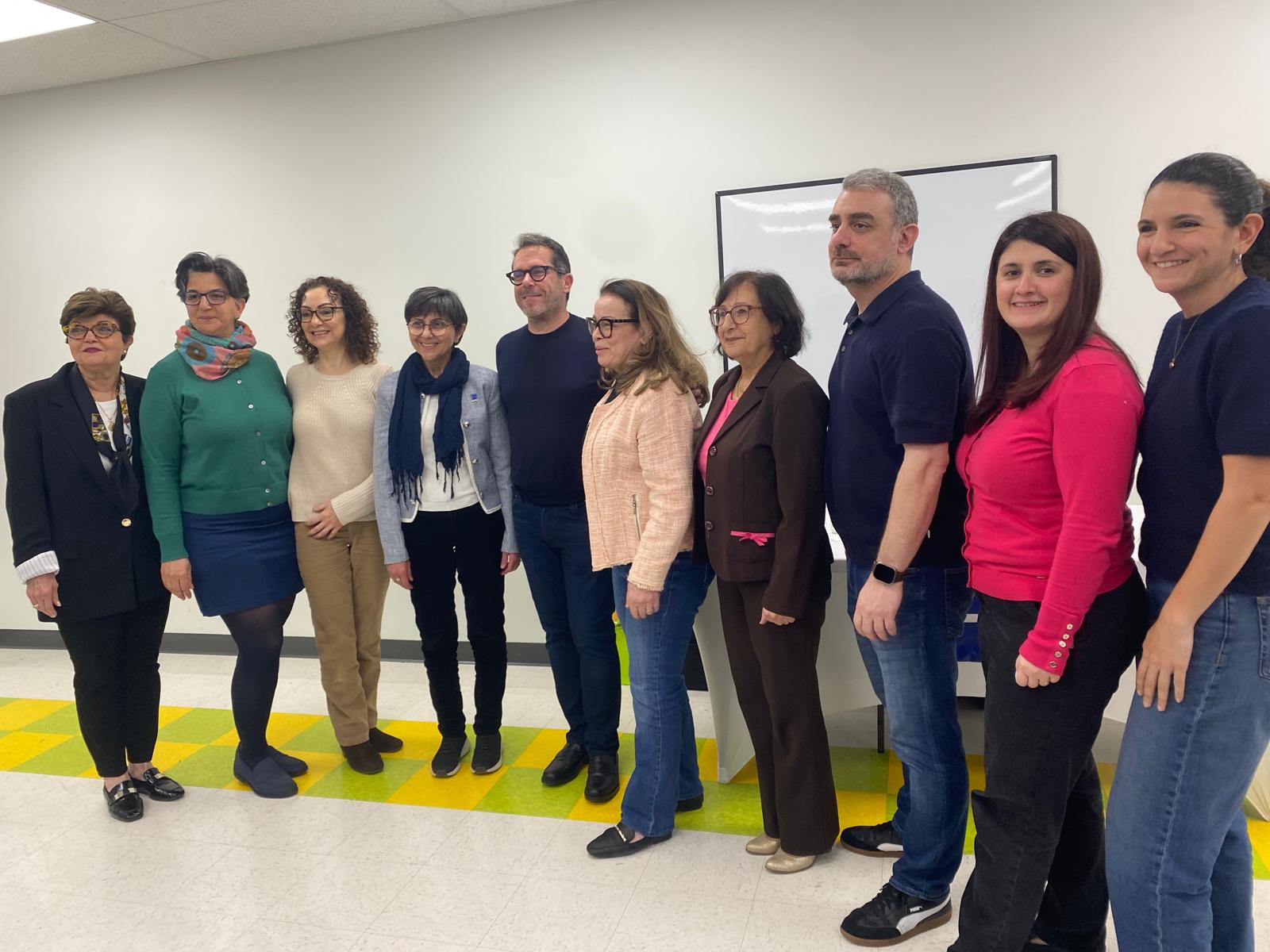
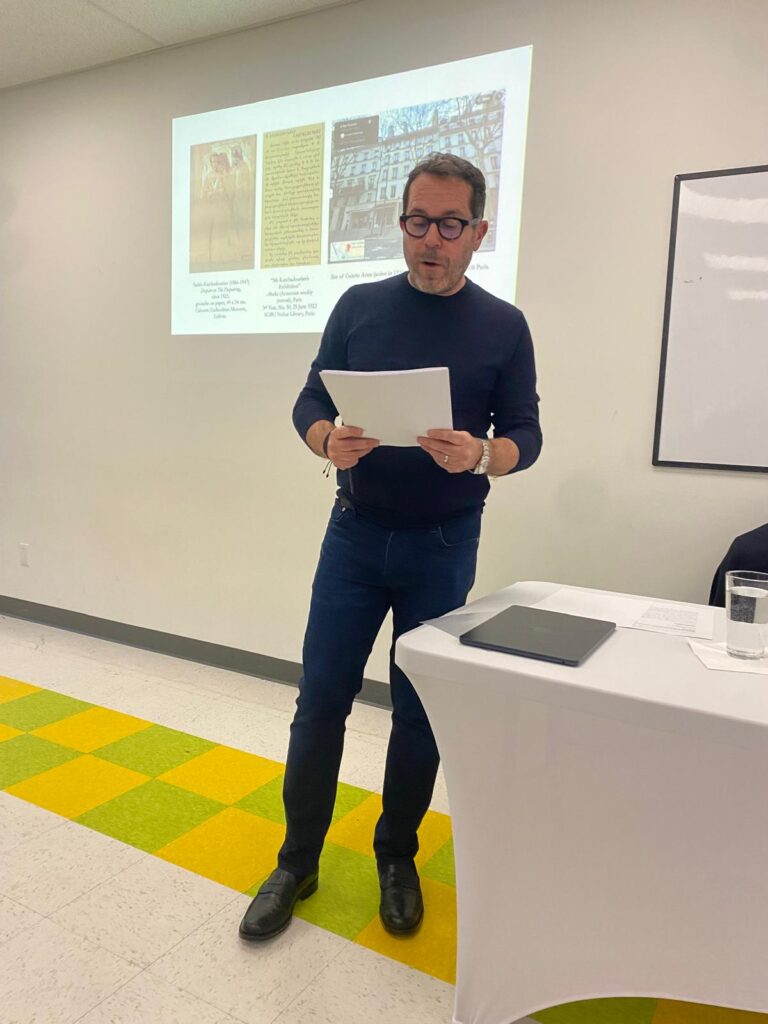
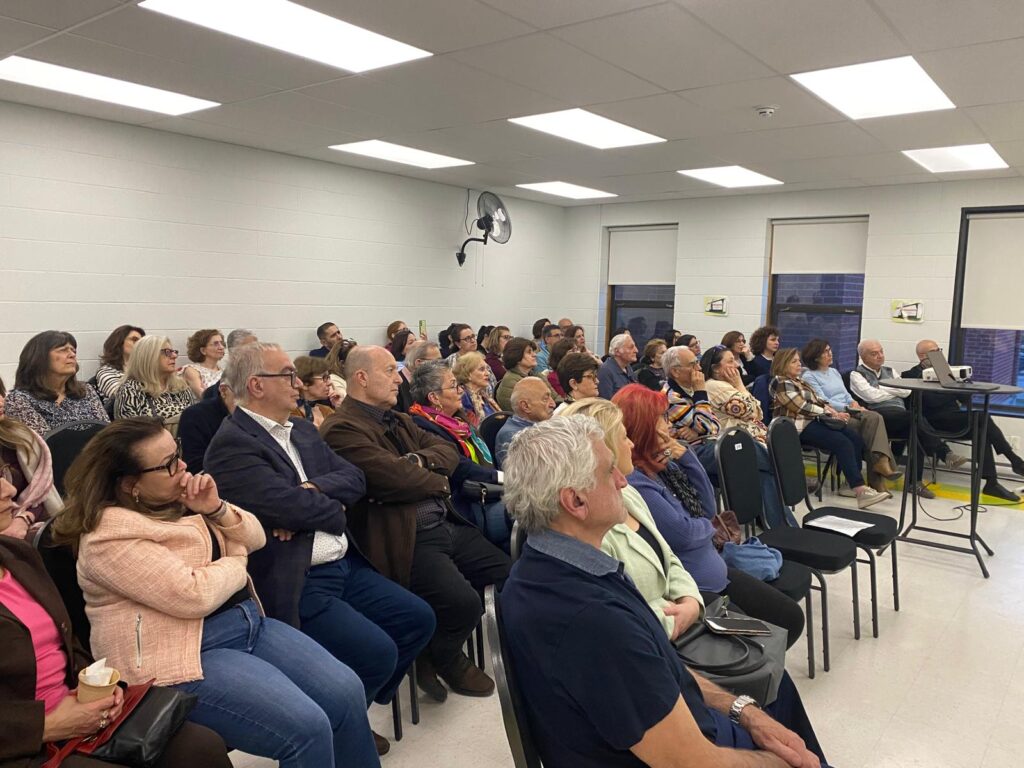
Dr. Vazken Khatchig Davidian was invited to Montreal by Dr. Vicken Tufenkjian in collaboration with the Hamazkayin Quebec “Sanahin” Chapter Literature Committee. His lecture was centred on Images of Despair and Survival: Revisiting Sarkis Khatchadourian’s Armenian Genocide Paintings.
In the late nineteenth and early twentieth centuries, the Ottoman Empire was a place of major political change, social upheaval, and cultural transformation. It was also a period in which artists painted the world around them — its cities, people, landscapes, and hostilities. For many artists of that era, especially those whose lives were shaped by genocide and displacement, their work was pushed to the margins of history. Paintings disappeared into private homes, archives, and museum storage rooms. In some cases, the artists themselves were nearly forgotten.
One such case was a painting by Sarkis Khatchadourian called Despair. The painting was sold at a Paris museum by Khatchadourian himself, only to be found later “stored safely in a drawer in the basement of the Calouste Gulbenkian Museum in Lisbon, Portugal.” “The undated painting is of three unnamed figures — two elderly women and a younger man — all huddled together and dressed in an oriental manner,” described Dr. Davidian during his lecture.
Dr. Davidian, a professor of art history, discussed his research on artists from the late Ottoman Empire whose works have been effectively “silenced” by the Armenian Genocide. His work focuses not only on the art itself, but also on the larger historical forces that shaped it. Rather than treating paintings simply as objects of beauty, he examines them as records of lived experiences — experiences marked by despair, loss, tragedy, and death during the period of the Hamidian massacres and the 1915 Armenian Genocide.
Dr. Davidian received an invitation to conduct research in the Gulbenkian archives, organized by architectural historian Alyson Wharton, author of the extensive 2015 book The Architects of Ottoman Constantinople: The Balyan Family and the History of Ottoman Architecture, which critically examines the family’s work and their role in Ottoman architectural history.
“She organized this workshop and invited six or seven art historians to look at different aspects of Armenian art collecting, Armenians as merchants of antiquities and art, and in my case, Armenians as collectors of Armenian artists,” said Dr. Davidian.
He found eight Khatchadourian paintings in the Gulbenkian collections, along with numerous documents. “They were all listed under the ‘Persian Period’ — Khatchadourian’s paintings were more well known for his Persian and Indian period — and I looked at Despair, that painting which was mislabeled and undated, and I knew it was from the 1920s.”
His research eventually uncovered exactly what it was. They took him to the basement of the Gulbenkian Museum and opened the drawer where it had been stored. “It hadn’t been seen in public in so many years. It had been mislabeled and completely forgotten.”
This discovery sparked a strong response in him. “I thought this is so typical of what has happened to Armenian history, to the Armenian Genocide… ‘go away, I don’t want to talk about it, let’s not discuss it.’”
He continued: “But in the last 30 years there is this new generation of historians who basically have done such amazing work on the Armenian Genocide that, at least as far as academia is concerned, the Armenian Genocide is one of the most documented and thoroughly researched genocides.”
“We have basically moved beyond that and are now looking at so many different aspects of the genocide. We’ve stopped looking only at those who died and started looking at those who survived. We’re asking more complex questions.”
“This picture has been forgotten. We need to take it out and make it public again.”
Dr. Davidian emphasized that in a visually driven world, imagery is the primary medium of representation. Khatchadourian’s connection to the subject is even more poignant, as he was himself a survivor of both the Hamidian massacres and the 1915 Armenian Genocide.
In his lecture, Davidian explained that the artist approached his paintings in two ways: the “witnessed” approach and the “imaginary” approach. The witnessed approach carries particular weight in Khatchadourian’s paintings because he personally encountered survivors. “He not only was helping them, but he was sketching them. He was able to produce all these sketches, and he spent ten years exhibiting these works around the world.”
“His works were popular, and people at that period knew both the paintings and the artist.” Eleven of those exhibitions were held in Paris alone.
Dr. Davidian’s research crosses several disciplines. It brings together art, history, anthropology, politics, and social history. These perspectives are not separate, but deeply interconnected. A painting does not exist outside the world in which it was created. The artist’s choices — what to paint, whom to portray, and what to leave out — are shaped by the social and political environment around them.
This observation is particularly evident in Khatchadourian’s Despair, where the artist places emphasis on the facial expressions and hands of the three unnamed figures in the portrait. The rest of the body, dressed in oriental attire, fades into the background, explained Dr. Davidian.
Focusing solely on formal elements such as colour and composition would neglect a work’s deeper significance. By employing a multidisciplinary approach, he seeks to understand not only the aesthetic surface of a work, but also the sociopolitical landscape of its time.
This approach is vital when studying artists impacted by systemic violence and historical erasure. During the late Ottoman period, genocide and displacement did more than destroy lives; they severed cultural continuity. As families were destroyed and institutions dismantled, artworks vanished into private collections or obscure archives. Consequently, entire artistic lineages were suppressed, remaining largely absent from public consciousness and scholarly discourse.
One of the important ideas discussed during the interview was the term “subaltern.” In simple terms, “subaltern” refers to people or groups whose voices have been excluded from dominant historical narratives. These are people who lived through history, but whose experiences were not fully recorded, preserved, or valued by those in power.
In the case of certain forgotten artists, it is not that their work lacked importance. Rather, the systems that shaped official history often excluded them. The paintings may have survived, but their stories, names, and contexts became fragmented or lost.
Working with archives, he said, is one of the most difficult parts of his research. Many people imagine archives as organized spaces where materials are carefully catalogued and easily accessible. In reality, that is often not the case. Important works may be stored in museum basements, uncatalogued or rarely examined. Others may remain in private homes, passed down through families who may not fully understand their historical significance.
At the same time, archival work can be deeply rewarding. Each rediscovered piece can raise new questions and reveal new connections. A single painting can offer insight into migration, community life, identity, or historical memory. In that sense, archival work becomes a form of reconstruction — carefully piecing together fragments of a larger story that history has scattered.
Dr. Davidian’s work is as ethical as it is scholarly. Reclaiming these artists does not erase the violence that once silenced them; rather, it performs a restorative act, creating space for their work to be seen on its own terms and ensuring that their legacy is no longer reduced to a footnote of displacement. Each recovered painting becomes more than an object from the past — it becomes a voice returning to the present.
Note:
The information was gathered from Dr. Davidian’s lecture presented to Hamazkayin Sanahin, Images of Despair and Survival: Revisiting Sarkis Khatchadourian’s Armenian Genocide Paintings, as well as from an interview conducted with Dr. Vazken Khatchig Davidian in Montreal, Quebec, in May 2026.
















Subscribe to our newsletter