
Հոկտեմբեր 06, 2026
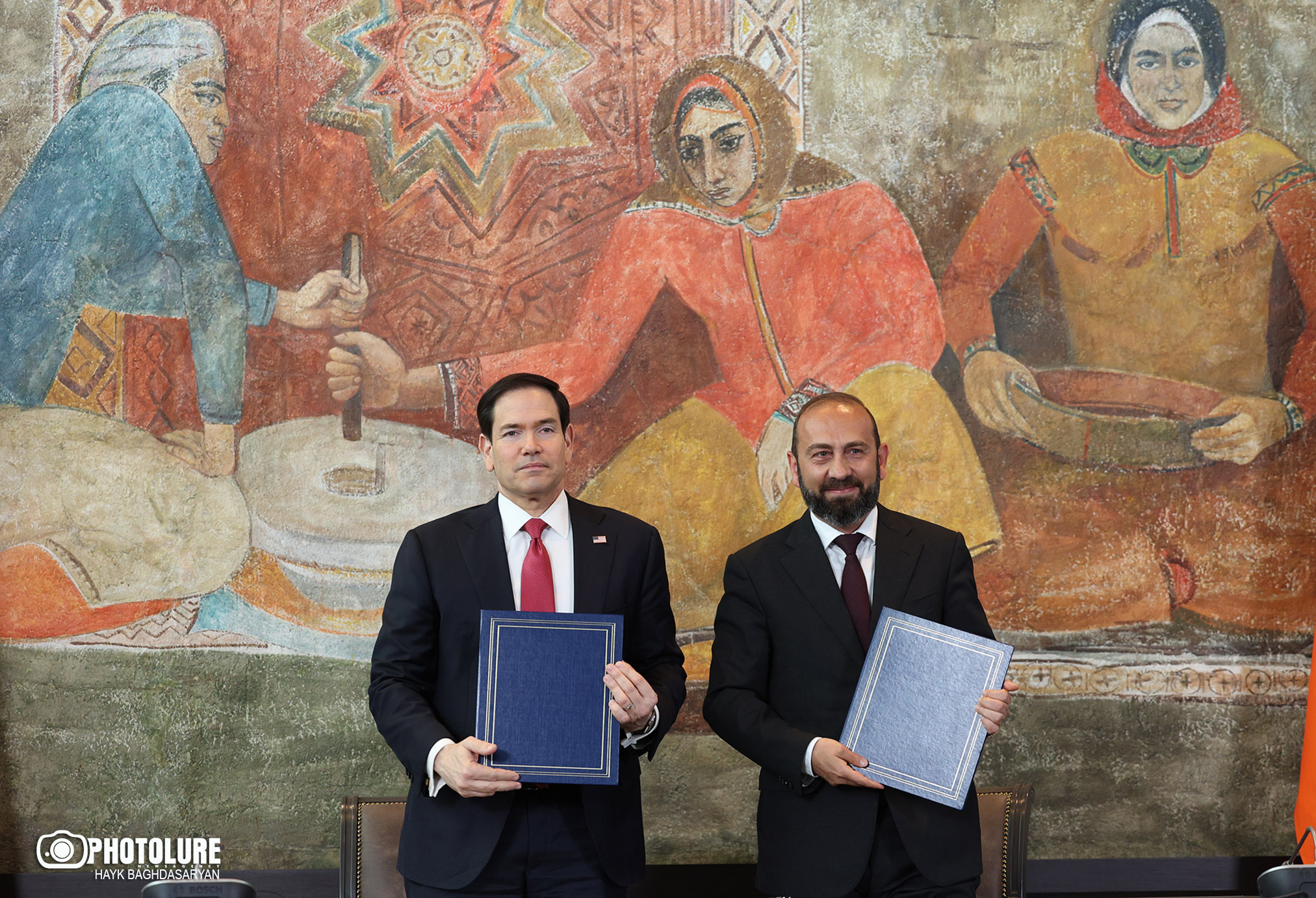
(Horizon Media / YEREVAN) – During a short visit to Yerevan, U.S. Secretary of State Marco Rubio and Armenian Foreign Minister Ararat Mirzoyan signed three agreements that significantly deepen American involvement in Armenia’s strategic infrastructure, security, energy and mining sectors. The agreements, centred around the TRIPP transit corridor, a new comprehensive strategic partnership charter, and critical minerals cooperation, are being presented as historic opportunities for regional integration and economic development. Yet the documents also raise serious questions about long-term sovereignty, control over strategic assets, and whether Armenia is truly positioned as the primary beneficiary of the arrangements.
The most consequential agreement signed in Yerevan was the TRIPP framework agreement, which establishes the political and legal foundation for a massive U.S.-Armenia joint venture overseeing strategic transit infrastructure projects across Armenian territory. The agreement repeatedly states that Armenia retains “full sovereignty, territorial integrity, and jurisdiction” over all TRIPP implementation areas, while simultaneously creating mechanisms that hand extensive operational, financial and developmental authority to a U.S.-controlled structure.
At the center of the agreement is the creation of the “TRIPP Development Company” (TDC), a joint-stock company to be incorporated in Armenia. The American side will participate through a Delaware-based entity wholly owned by the U.S. International Development Finance Corporation (DFC), while Armenia itself will hold the remaining shares. Under the agreement, the U.S. side will control 74% of the TDC, leaving Armenia with only 26%.
The arrangement is designed to last at least 49 years. At the end of that period, the agreement allows for a further 50-year extension by mutual consent, at which point Armenia’s share would rise to 49%, while the American side would still maintain majority control with 51%.
The TDC will oversee railways, highways, pipelines, fibre-optic infrastructure and electricity projects under the broader TRIPP framework. The agreement directly links the corridor to the creation of uninterrupted transit connectivity between Azerbaijan proper and Nakhchivan through Armenian territory.
One of the most controversial sections concerns land and development rights. Armenia agrees to ensure that lands designated for TRIPP implementation either become state property or remain under state control, free from third-party claims, while Armenia itself bears all associated financial costs. Once the implementation zones are finalized, Armenia is obligated to grant the TDC exclusive land-use and development rights for 49 years, rights which can then be transferred to subsidiary entities created for specific projects.
Although Armenia formally remains the sovereign grantor of concessions, the agreement gives the TDC authority to select concessionaires, operators, contractors and engineering providers, as well as develop the concession terms themselves. The agreement also requires Armenia to adopt deviations from Armenian legislation concerning procurement, public-private partnerships and joint-stock company regulations in order to facilitate the functioning of the TDC.
The agreement additionally creates a highly favourable tax regime for the American-led structure. Dividends distributed to the U.S. side will be exempt from Armenian taxation, and the TDC and its subsidiaries will also be exempt from capital gains taxes and taxes on transfers of development rights.
The customs and border sections are particularly sensitive politically. While Armenia retains formal authority over customs, immigration and security operations, the agreement commits Armenia to introducing private operators for customer-facing services at border crossings within TRIPP zones, subject to mutual agreement with the TDC. The agreement also references “front office/back office” border management systems linked to the broader TRIPP implementation framework.
Although the document repeatedly emphasizes Armenian sovereignty, critics point to the extraordinary scale of foreign operational control embedded within the agreement. The combination of a 74% American ownership structure, half-century exclusive development rights, legislative exemptions, tax privileges, and major influence over strategic infrastructure creates the impression of a corridor in which Armenia maintains formal sovereignty while ceding substantial practical authority over key national assets and transit systems. The agreement also raises broader geopolitical questions about whether Armenia’s role is primarily that of a sovereign economic partner or a transit platform serving larger American regional and commercial interests.
The second agreement signed in Yerevan establishes a sweeping new political, economic and security framework between Armenia and the United States. The charter significantly expands bilateral cooperation across defence, energy, nuclear technology, artificial intelligence, semiconductors, cybersecurity, education, telecommunications, mining and regional connectivity.
The document openly supports Armenia’s deeper integration into the “Euro-Atlantic community” and describes a strong, technologically advanced and regionally integrated Armenia as essential to regional stability. It also strongly endorses both the August 8, 2025, Washington peace summit and the TRIPP initiative as central pillars of a new regional order.
The charter contains some of the most extensive U.S.-Armenia defence provisions signed since Armenia’s independence. The two countries commit to expanding military cooperation by facilitating the potential sale of American weapons systems and auxiliary equipment to Armenia under the Foreign Military Sales program, while also increasing Armenian participation in American military training and education initiatives such as IMET.
The agreement further outlines cooperation on border security, cyber defence, intelligence sharing, anti-money laundering, anti-terrorism operations, export controls, countering organized crime and preventing weapons proliferation. It also encourages the development of Armenia’s domestic defence industry in cooperation with U.S. partners.
Economically and technologically, the charter lays the groundwork for extensive American involvement in Armenia’s future strategic sectors. It includes support for the development of Armenia’s civil nuclear sector, possible deployment of small modular nuclear reactors, access to American nuclear fuel and technologies, cooperation on semiconductor supply chains and artificial intelligence, and efforts to strengthen Armenia’s digital infrastructure and energy resilience.
The agreement also expands cooperation into the space sector, including discussions surrounding Armenian participation in NASA-related initiatives, CubeSat missions and satellite communications projects. Educational exchanges, scientific cooperation and cultural heritage preservation initiatives are also incorporated into the charter.
Supporters will likely present the charter as evidence of Armenia’s growing strategic importance to Washington and a major shift away from Russian dependency. However, the document also reflects how deeply Armenia is being integrated into broader American geopolitical, technological and security frameworks at a moment of major regional transformation. The charter speaks extensively about strengthening Armenia’s resilience and sovereignty, yet much of the practical implementation depends on long-term American involvement in sectors increasingly tied to national security and strategic infrastructure.
The third agreement signed in Yerevan focuses on critical minerals and rare earths, sectors that have become strategically vital due to their importance in advanced technologies, artificial intelligence, defence industries and global supply chains.
Unlike the TRIPP agreement, this framework is explicitly non-binding and does not create legally enforceable obligations. Nevertheless, it establishes a broad roadmap for deep U.S.-Armenia cooperation in mining, refining, processing and exporting strategic minerals.
The agreement aims to create resilient supply chains for critical minerals while prioritizing the development of separation, refining and value-added processing capabilities inside Armenia. The two countries intend to mobilize public and private financing through guarantees, loans, equity investments, insurance and long-term offtake arrangements. Within six months, both sides plan to explore potentially significant financing mechanisms for projects serving American and Armenian markets.
The agreement also grants both sides a “prioritized opportunity” to invest in Armenian critical mineral assets. It further includes cooperation in geological mapping, the creation of an Armenian Geological Survey, technology transfer, workforce training, recycling initiatives, and the modernization of mining operations.
Importantly, the framework directly links the minerals strategy to the TRIPP corridor, emphasizing the transit route’s role in moving critical minerals from the South Caucasus and Central Asia toward international markets.
While the agreement is framed as an opportunity for economic development and technological modernization, it also reinforces a broader pattern visible across all three agreements: Armenia’s strategic geography, infrastructure and natural resources are increasingly being integrated into larger American geopolitical and commercial objectives. Supporters may argue that Armenia is leveraging great-power competition to secure investment and security guarantees, but critics are likely to question whether the long-term balance of benefits and control disproportionately favours Washington over Yerevan.


















Բաժանորդագրվել
