IODA warns of political repression and democratic backsliding in Armenia, urges EU action
- (0)
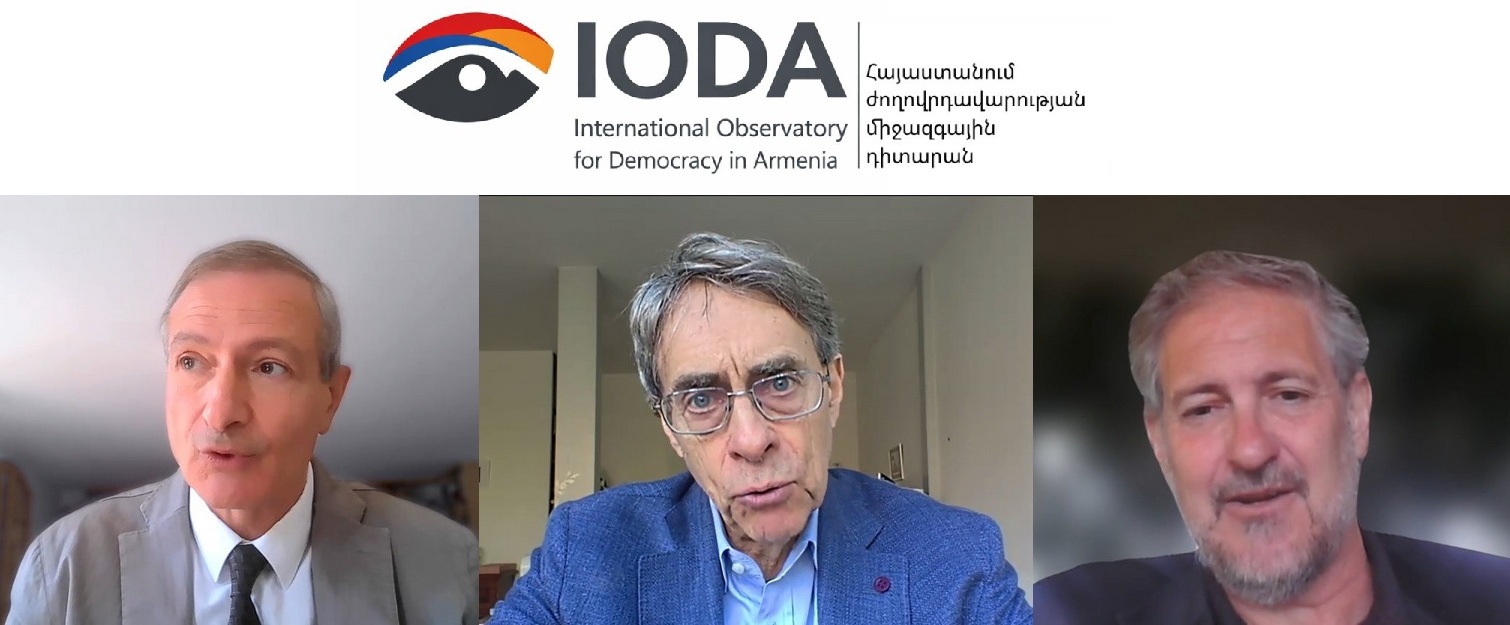
(Horizon Media / YEREVAN) – The International Observatory for Democracy in Armenia (IODA) has warned that political repression, pressure on opposition figures and the Armenian Apostolic Church, and increasing executive interference in law enforcement are driving democratic backsliding in Armenia. During an online press conference, IODA Executive Board members Kenneth Roth, Philippe Kalfayan and José Aranas said developments before and after Armenia’s June 7 parliamentary elections reveal a broader authoritarian trend rather than a series of isolated incidents.
The speakers focused particularly on arrests and investigations targeting opposition figures and former senior officials, including cases in which public statements by Prime Minister Nikol Pashinyan were followed by law-enforcement action. IODA Executive Board member Philippe Kalfayan said the Armenian government’s own conduct has demonstrated the existence of political prisoners, pointing to detentions carried out without charges and arrests announced politically before legal proceedings had begun.
“The government itself has proven that there are political prisoners in Armenia,” Kalfayan said. He cited opposition figure Avetik Chalabyan, who was detained following the parliamentary elections and later released, as an example of politically motivated prosecution. Kalfayan also pointed to recent action against former President Robert Kocharyan, his son Sedrak Kocharyan and Prosperous Armenia leader Gagik Tsarukyan.
Robert and Sedrak Kocharyan were detained on August 25 in a criminal investigation involving allegations of abuse of office, bribery and money laundering, while former President Serzh Sargsyan was summoned to the Anti-Corruption Committee. Kalfayan stressed that IODA was not determining the merits of individual corruption allegations, but said the repeated pattern of political declarations by Pashinyan preceding arrests and investigative measures raises serious concerns over the independence of Armenia’s justice system.
Kenneth Roth, former executive director of Human Rights Watch, said IODA had already warned before the elections that authoritarian tendencies were becoming increasingly evident in Armenia. He said Pashinyan and his government used state powers during the election period to pressure opposition candidates, critical journalists and the Armenian Apostolic Church, while presenting many of these actions to Western governments as necessary measures against Russian interference.
Roth said Western governments largely overlooked these abuses because of Armenia’s geopolitical shift away from Moscow. “The executive dictates, and the justice system carries out its instructions,” he said, pointing to the detention of Robert Kocharyan and his son and the summoning of Serzh Sargsyan shortly after public statements by Pashinyan as further evidence of political interference in law enforcement and judicial processes.
Roth also sharply criticized the European Union’s response, urging Brussels to stop overlooking democratic abuses because Armenia is pursuing closer relations with the West. “Does the EU want Armenia simply to become a pro-Western dictatorship, or does it want a democracy?” he asked, saying Armenia has become an important test of whether the EU is prepared to uphold democratic principles when dealing with a government seeking closer political alignment with Europe.
The issue has gained additional significance following Pashinyan’s announcement that Armenia intends to begin a process aimed at eventual EU membership. Roth said closer relations with Europe must remain tied to democratic standards, judicial independence and the Copenhagen criteria rather than geopolitical orientation alone. José Aranas made the same point, stressing that authoritarian rule is fundamentally incompatible with European integration and that “the road to the EU is one of genuine reforms, the rule of law, and respect for the law.”
IODA also raised serious concerns over the Pashinyan government’s confrontation with the Armenian Apostolic Church. Roth said the government has no right to interfere in the Church’s internal affairs or attempt to silence it when it speaks on political and national issues, stressing that religious institutions have the same right as other independent voices to participate in public debate.
“The Church, anywhere in the world, is an independent voice in society and must be respected,” Roth said. He added that political and legal pressure aimed at preventing the Church from criticizing government policy is anti-democratic and violates fundamental freedoms. Roth also emphasized that freedom of expression applies equally to the Armenian Diaspora and cannot be limited by national borders.
Aranas said the pressure on opposition forces, democratic institutions, constitutional principles and religious freedoms forms a consistent pattern rather than disconnected incidents. IODA called on the European Union and other Western governments to respond more decisively and to make democratic standards a substantive condition of closer relations with Yerevan.
For Roth, Armenia is now a test of whether the EU will defend democratic principles even when the government in question is politically aligned with the West.
Related Articles
October 22, 2026
What did Carney and Erdogan sign in Ankara?
October 22, 2026