October 22, 2026
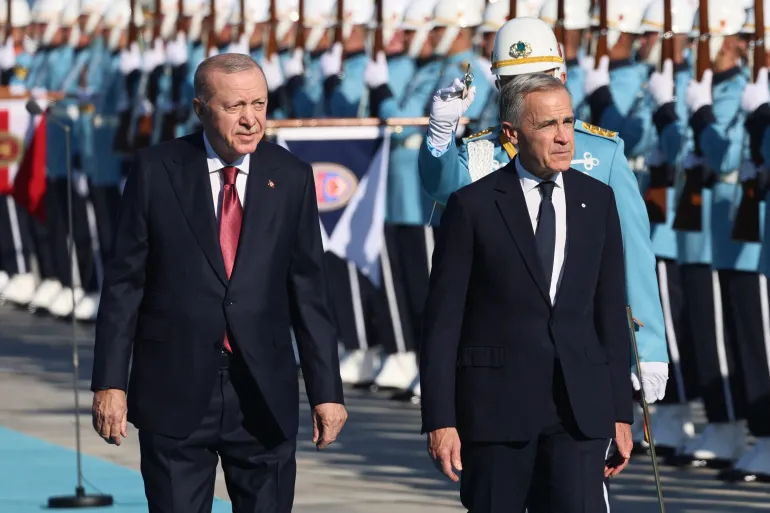
ANKARA/OTTAWA— Prime Minister Mark Carney and Turkish President Recep Tayyip Erdogan announced a new Canada–Turkey Strategic Partnership on Thursday, October 22, signing agreements covering defence, energy and air transportation while committing to closer economic and diplomatic relations.
The announcement, made during the first dedicated bilateral visit to Turkey by a Canadian prime minister, marks a significant expansion of relations between the two NATO allies. It forms part of Carney’s broader strategy to diversify Canadian trade and reduce economic dependence on the United States.
The partnership establishes a three-year action plan covering trade and investment, defence and security, energy, and diplomatic and cultural relations.
Both governments agreed to advance negotiations toward a comprehensive free trade agreement, with talks scheduled to resume in Ankara in November. Erdogan outlined ambitions to increase bilateral trade from approximately US$3 billion to US$5 billion initially, and eventually US$10 billion.
Energy cooperation is another major component, with discussions involving liquefied natural gas, critical minerals and civilian nuclear technology, including potential Canadian participation in Turkey’s nuclear expansion through CANDU reactors.
The governments also signed a defence cooperation agreement intended to facilitate closer collaboration between their military industries. Although no major weapons procurement contracts were announced, the agreement establishes a framework for future partnerships involving sensitive defence technologies.
The Armenian National Committee of Canada (ANCC) has warned that closer economic and military cooperation with Ankara must not undermine Canada’s human rights commitments, national security interests or longstanding foreign policy principles.
In comments published by The Globe and Mail, ANCC national board member Sevag Belian questioned the implications of Carney’s foreign policy approach, described by the government as “values-based realism.”
“Values-based realism must not become a convenient justification for compromising fundamental principles in pursuit of economic or strategic interests,” Belian told the newspaper.
Speaking to CTV News, Belian acknowledged the government’s efforts to diversify trade but questioned Turkey’s suitability as a partner, citing its human rights record and destabilizing role in the region.
“We just do not believe at all that Turkey is the right partner,” he said, describing the Armenian community’s reaction to the visit as one of “alarm and concern.”
The concerns have also figured in CBC News’ reporting on the visit, particularly regarding the implications of expanded defence cooperation and Ottawa’s balancing of economic interests against human rights considerations.
The defence agreement is especially sensitive given Canada’s previous experience with Turkish military exports. During the 2020 Artsakh war, Canadian-manufactured targeting technology installed on Turkish Bayraktar drones was used by Azerbaijani forces against Armenian positions.
Following an investigation, Ottawa cancelled 29 military export permits to Turkey in 2021, concluding that the equipment had been used contrary to Canadian foreign policy and the end-use assurances provided by Ankara. Canada subsequently eased its military export restrictions in 2024.
In September, the ANCC formally urged Global Affairs Canada to ensure that any future free trade agreement preserves strong export controls, prevents the unauthorized transfer of Canadian technology and maintains Canada’s ability to respond to violations of international humanitarian law.
The latest agreement therefore raises questions about whether additional safeguards will be introduced to prevent Canadian military technology from once again being used in conflicts contrary to Ottawa’s stated foreign policy positions.
Beyond defence cooperation, the ANCC has raised concerns about possible diplomatic pressure concerning Canada’s recognition of the Armenian Genocide.
In his CTV interview, Belian warned that Ankara could attempt to place the issue on the negotiating table, while expressing hope that the Canadian government “won’t budge.”
Canada formally recognized the Armenian Genocide in 2004, a position reaffirmed by successive governments. No change to that policy has been announced.
Other unresolved concerns include Turkey’s longstanding military support for Azerbaijan, the forced displacement of more than 120,000 Armenians from Artsakh in 2023 and the continued detention of Armenian prisoners in Azerbaijan.
Meanwhile, international human rights organizations have criticized Erdogan’s government over its treatment of political opponents, restrictions on independent media and recent crackdowns targeting LGBTQ+ organizations and civil society. Turkish authorities reject allegations of politically motivated prosecutions.
For Ottawa, Turkey offers substantial commercial opportunities and an influential NATO partner at a time of growing international economic uncertainty. Those considerations help explain Carney’s diplomatic approach, but they do not resolve the questions surrounding Ankara’s domestic and regional conduct.
The agreements signed in Ankara represent a substantial political commitment, but many of their practical consequences remain to be determined. In particular, Ottawa has not publicly explained what additional safeguards, if any, will accompany expanded defence cooperation.
The partnership also raises broader questions about the practical limits of the government’s “values-based realism” approach. While economic diversification is a legitimate national priority, the decision to strengthen strategic ties with Ankara brings Canada’s commercial ambitions into tension with its longstanding commitments on human rights, international law and regional security.
As Canada moves toward closer strategic relations with Turkey, the challenge will be to demonstrate that economic pragmatism does not come at the expense of the principles, protections and international commitments the government has repeatedly pledged to uphold.
















Subscribe to our newsletter

