September 16, 2026
By The Center for Armenian Research and Analysis*
In 2025, Armenia’s Civil Contract party presided over the systematic dismantling of Armenia’s foreign policy foundations. Prime Minister Nikol Pashinyan labelled this period an “era of peace,” yet in reality, he unravelled Armenia’s security architecture and surrendered territory and authority in exchange for unenforceable, often unrealistic, diplomatic assurances.
Supporters of the administration claim that Armenia’s capitulation was inevitable, blaming global economic shifts, changing power centers, and the apathy of traditional allies. This narrative distorts the reality of statecraft. While external pressures were real, the administration’s choice to trade away sovereign leverage rather than build asymmetric deterrence was a conscious policy, not an unavoidable outcome.
The pattern seen in 2025 is unmistakable: Azerbaijan exploited the multipolar order to expand its influence through force and new alliances, while Armenia systematically forfeited its own. As a result, Armenia’s security eroded, foreign influence deepened, and sovereignty over vital infrastructure became little more than a formality. The so-called peace process of 2025 was, more accurately put, a managed capitulation.
At the start of the year, Baku sent a clear message that Yerevan either ignored or downplayed. In a January TV interview, President Ilham Aliyev signalled Azerbaijan was preparing for renewed military operations against Armenia, using language similar to Russia’s actions in Ukraine. He demanded that Armenia demilitarize, “denazify,” stop obstructing regional trade routes, and he also officially demanded that so-called “Western Azerbaijanis” return to Armenia’s sovereign territory.
Confronted with an explicit threat, Armenia’s leadership failed to reinforce its defensive alliances. The Pashinyan administration remained inert as Aliyev swiftly engaged the incoming U.S. administration, sending a congratulatory letter to President Donald Trump and attacking Section 907 restrictions as unfair Biden-era constraints. This calculated outreach paid immediate dividends. A bipartisan U.S. congressional delegation travelled to Baku to discuss lifting these restrictions. The episode exposed the impotence of Armenia’s diplomatic presence in Washington, coupled with the self-inflicted damage to Armenian advocacy networks in the U.S.
By March, peace negotiations collapsed over transport guarantees and the Nakhichevan corridor, while Azerbaijan aggressively expanded its security and economic alliances. U.S. Special Envoy Steve Witkoff arrived in Baku to formalize a trilateral partnership with the U.S. and Israel. Simultaneously, SOCAR secured exploration rights in Israel, deepening an energy axis that shielded Baku from Western leverage. Yerevan, meanwhile, offered no comparable strategy.
In April, Armenia’s parliament passed legislation on EU accession, branding it a “historic pivot westward.” In reality, this maneuver provided no tangible security guarantees. Its hollowness was exposed almost immediately. Azerbaijani forces attacked Khoznavar in Syunik and staged military exercises in Nakhichevan. As Yerevan appealed to Brussels for support, Aliyev travelled to Beijing to deepen Azerbaijan’s partnership with China, further anchoring Baku in the much-touted “Belt and Road” transport and supply chain initiative.
By May, the regional power imbalance had only deepened. Although Israeli Prime Minister Benjamin Netanyahu cancelled a visit to Baku due to Turkish airspace restrictions, the Azerbaijan-Turkey axis remained unshaken. Their partnership was further cemented by a $304 million U.S. missile sale to Turkey, permitting the historic allies to continue making extraterritorial demands on Armenia. At the same time, Azerbaijan and Iran conducted the “Aras-2025” joint military exercises in the occupied Armenian territories. These developments underscored Baku’s diplomatic agility, a quality entirely absent from Armenia’s foreign policy.
In June, Azerbaijan dramatically expanded its military capabilities, purchasing 40 JF-17 Thunder fighter jets from Pakistan for $4.6 billion. Meanwhile, Prime Minister Pashinyan travelled to Istanbul for normalization talks with President Erdoğan. Throughout these discussions, Turkey and Azerbaijan maintained relentless pressure to mandate the creation of a so-called “Zangezur Corridor,” advancing their project to transform Turkey into Eurasia’s primary logistics hub at the direct expense of Armenia’s territorial sovereignty.
In July, groundwork was laid for a sweeping and irreversible concession. Aliyev and Pashinyan met in Abu Dhabi, giving President Trump the opportunity to declare the conflict resolved. Simultaneously, Aliyev showcased Azerbaijan’s expanding regional clout by signing gas export agreements with Syria.
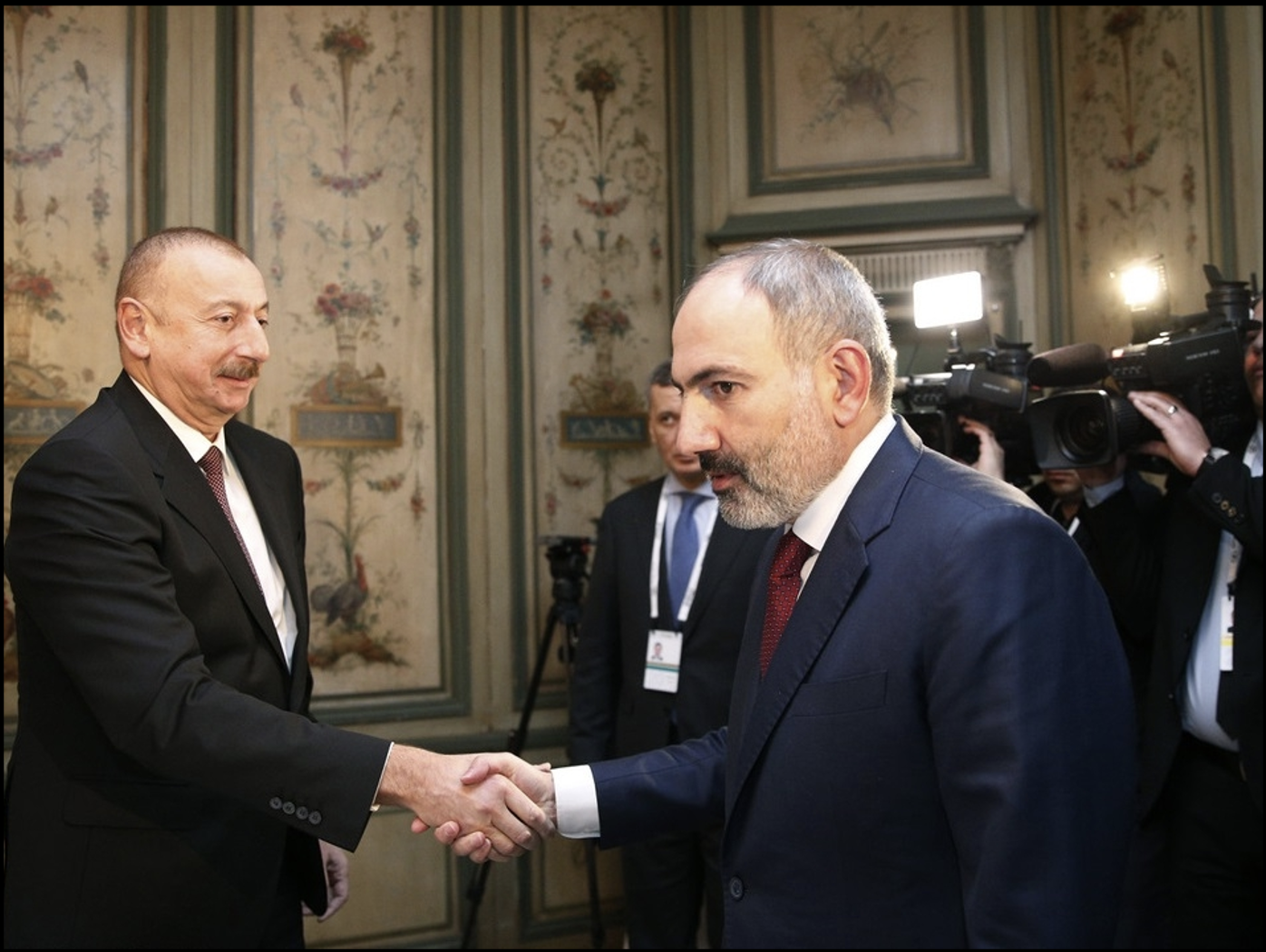
In August, a trilateral summit in Washington between Presidents Trump and Aliyev and Prime Minister Pashinyan produced a joint declaration. Marketed as a purported “historic peace,” the agreement, in reality, stripped Armenia of state sovereignty by creating the so-called “Trump Route for International Peace and Prosperity” (TRIPP).
Administration loyalists insist the TRIPP framework was necessary to avert a larger war (previously dismissed as “provocative rhetoric”). In reality, rebranding the “Zangezur Corridor” as TRIPP merely repackaged the same surrender for Western consumption. By granting the U.S. exclusive development rights for 99 years over a 42km stretch in southern Armenia, the Pashinyan government relinquished control over a critical national asset and a lynchpin of continued Armenian sovereignty.
To fully grasp the sheer magnitude of this failure, one must trace the origin of the “Zangezur Corridor” demand back to the November 9, 2020, trilateral ceasefire statement. Article 9 of that capitulation document mandated the unblocking of regional transport links—a vague provision agreed to by Yerevan under the extreme duress of an imminent, total military collapse. Crucially, this vulnerability was entirely self-inflicted. As Prime Minister Pashinyan startlingly admitted to the Armenian parliament in April 2022, he was offered a significantly better ceasefire agreement weeks earlier in the 2020 war: a deal that would have halted the bloodshed, preserved Armenian control over key areas like Shushi, and avoided disastrous transit concessions.
Yet, by his own confession, he rejected that earlier deal strictly due to domestic political calculations, specifically the paralyzing fear of being labelled a “traitor” by his domestic opposition. He deliberately chose to absorb thousands of additional casualties and total military defeat rather than face immediate domestic backlash. Consequently, when the final November 2020 agreement was signed, Armenia had zero negotiating leverage, allowing Baku and Ankara to weaponize Article 9 into a maximalist demand for an extraterritorial corridor. The 2025 TRIPP agreement is simply the finalized, fatal maturation of a concession born from the Pashinyan administration’s political cowardice five years prior.
Following the Washington summit, Azerbaijan lifted transit restrictions, allowing the first Kazakh grain shipment into Armenia. Yerevan touted this as a diplomatic victory. Yet, Baku flatly rejected U.S. and French appeals to release detained Artsakh leaders, making clear that economic transit yielded neither political goodwill nor improved security.

The deal in Washington did not eliminate Armenia’s existential threat; it codified it. In September, by the Pashinyan administration’s own account, state media in Baku ramped up the “Western Azerbaijan” narrative by 36 percent, again demonstrating territorial ambitions against Armenia remain official policy despite the so-called peace.
Diplomatic momentum shifted decisively to Baku. The UK elevated relations to a Strategic Partnership, and the U.S. established a bilateral working group focused solely on implementing the connectivity agreements. Foreign Ministers convened in New York not to negotiate, but to oversee the logistics of these one-sided arrangements.
By October, the total dismantling of Armenia’s previous security architecture was formalized on the world stage. In Copenhagen, Aliyev and Pashinyan welcomed the dissolution of the OSCE Minsk Group. This was not a mutual step forward; it was the removal of the very last international legal framework that officially recognized the Artsakh issue as unresolved. Shortly thereafter, Azerbaijan hosted the Organization of Turkic States (OTS) Summit in Gabala, solidifying the region’s pan-Turkic economic and military integration. Aliyev held strategic meetings with U.S. Central Command, entrenching, deeper, Baku’s indispensability to Washington’s military footprint in the region.
By year’s end, the region’s strategic situation had changed quite a bit. Armenia was more isolated, while Azerbaijan joined several global alliances. In November, Azerbaijan became the first non-founding member of the consultative platform of the Central Asian republics. Baku issued international arrest warrants for exiled journalists and continued to show its strong internal control with little concern for Western human rights pressure. In turn, an Armenian parliamentary group visited Istanbul to further subjugate Armenia to a Turkic sphere of influence.
In December, the final mechanisms of the previous status quo were dismantled. Turkey and Armenia announced visa simplification for diplomats—a superficial diplomatic gesture that provided excellent optics for Ankara. Simultaneously, the sham trial of Artsakh leaders reached its predetermined conclusion in Baku, cementing a profound national humiliation that the Armenian government was entirely powerless and uninterested in preventing or protesting.
Unperturbed by Yerevan, Azerbaijan and Turkey moved forward aggressively, approving a comprehensive 110-point action plan to further integrate their economies and transport networks. Finally, an official bill was introduced in the U.S. House of Representatives to formally repeal Section 907, threatening to strip away the absolute last vestige of U.S. legislative leverage against Azerbaijani aggression.
The Pashinyan administration claims to be the region’s main democratic actor in Western capitals, but at home, it has quickly become a bastion of authoritarian practices. The government often says restrictions on civil liberties are needed to protect the “constitutional order” from subversive groups, but evidence shows otherwise. Democracy relies on strong institutions, yet Prime Minister Pashinyan has centralized power, as shown by his statement, “The government is me.” This has led to the removal of independent voices from the judiciary, including resignations from the Supreme Judicial Council, and the use of law enforcement for political purposes. Groups like Amnesty International have reported more force being used in protest policing, evidenced by the deployment of elite, special paramilitary units and the increased use of stun grenades and other anti-personnel weapons against peaceful protesters. The unlawful detention and arrest of opposition activists, dissidents and journalists has risen dramatically with heightened aggression by the Pashinyan regime against the Armenian Apostolic Church aimed to weaken its leadership and influence.
The main goal of the 2018 Velvet Revolution—to end systemic corruption—has become just a facade. Transparency International reported that Armenia made no progress on its Corruption Perceptions Index last year. The Pashinyan administration has exploited anti-corruption bodies for political revenge rather than reform. Supporters of the ruling party point to these bodies as proof of progress, but their selective use tells a different story. Major corruption scandals in the Civil Contract party are protected by state prosecutors. When investigative journalists and OCCRP exposed large campaign finance violations by Civil Contract, including a network of “straw donors” to bypass financial limits, law enforcement quickly closed the case without reason. High-ranking officials act with complete impunity; for example, the Parliament Speaker has been linked to multimillion-dollar contract scandals and to the concealment of luxury real estate through proxies, facing no legal or reputational consequences.
The erosion of Armenia’s democratic standards is inseparable from the administration’s foreign policy failures. The government’s professed allegiance to Western democratic values stands in stark contrast to its dealings with authoritarian regimes abroad. By embracing the same centralized and repressive methods as the states it claims to resist, the Civil Contract administration has undermined Armenia’s internal resilience. In the end, the Pashinyan regime’s purported pursuit of “security “ has destroyed democratic cohesion, leaving Armenia with neither.
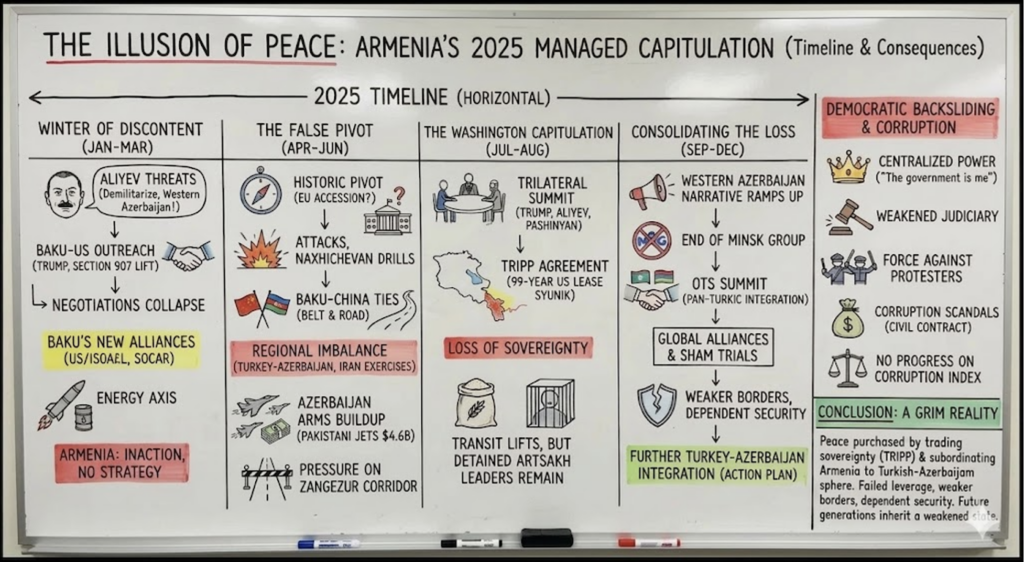
The historical record of 2025 illustrates a grim and undeniable reality. The crisis facing the Armenian state is not exclusively the result of shifting geopolitical winds; it is the direct consequence of the Pashinyan administration’s deliberate policy choices and consequential actions. By trading sovereignty over Syunik via the 99-year TRIPP lease and actively facilitating the erasure of Artsakh’s legacy, the government has purchased a manufactured “peace” in word only that subordinates Armenia to a Turkish-Azerbaijani sphere of influence, underwritten by U.S. economic interests.
In today’s world of competing powers, Armenia’s ruling Civil Contract party failed to build leverage, balance interests, or show deterrence. Instead, it gave in to internal pressure from the outside and used democratic language to justify major concessions and to justify both choreographed and inherent failures. Because of this, future generations in Armenia will inherit a country with weaker borders, less diplomatic influence, and a security system that depends on uncertain support from neighbours and distant powers.
And now, as Armenians head to the polls in June, the Armenian government’s increased focus on domestic political suppression will continue to undermine any prospect of meaningful advancement of Armenia’s foreign policy objectives, at the expense, once again, of Armenia’s citizens and their progeny.
* The Center for Armenian Research and Analysis is a trans-national institute that provides investigative, analytic, and informational resources to public and private entities across the Armenian experiential spectrum.

















Subscribe to our newsletter