
Հոկտեմբեր 06, 2026
By Sevag Belian
A renewed political controversy has emerged over the origins and consequences of the October 6, 2022, Prague quadrilateral statement, with conflicting narratives from Armenian Prime Minister Nikol Pashinyan and French President Emmanuel Macron raising deeper questions about responsibility, intent, and long-term implications for Armenia’s national interests.
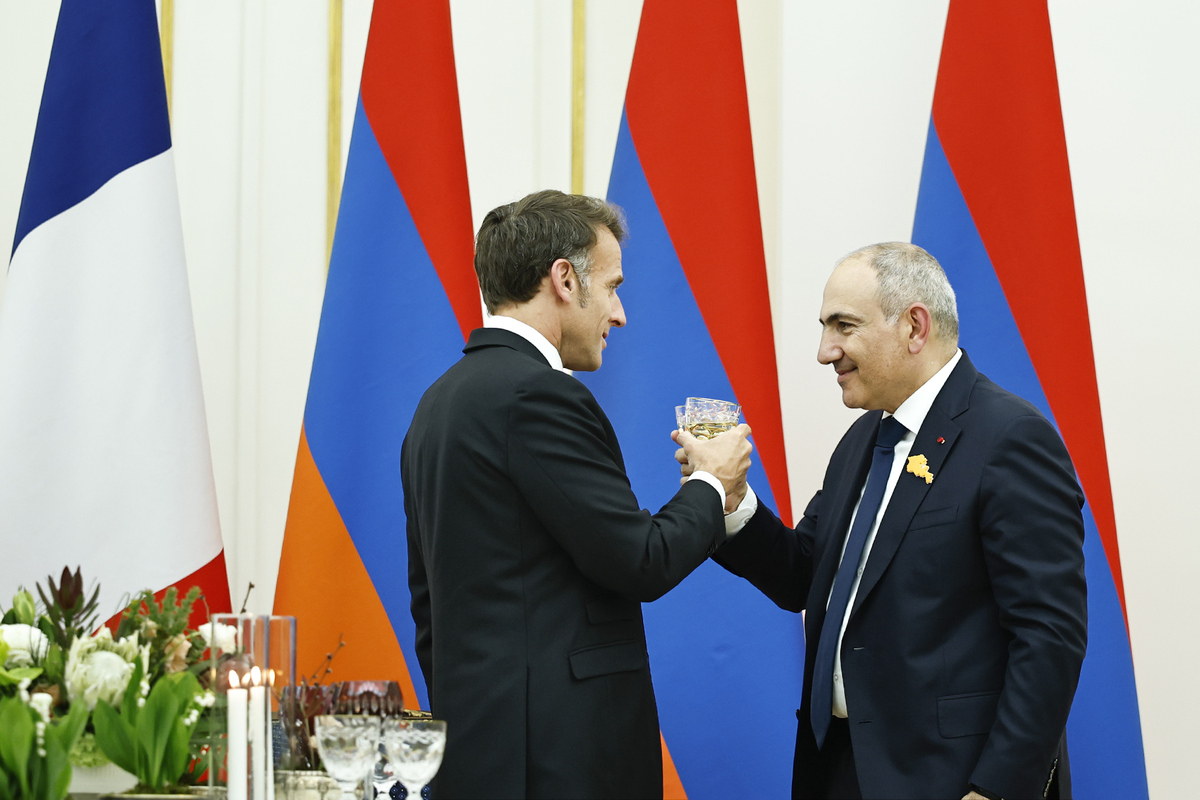
Recent remarks made during a state dinner in Yerevan have brought the issue back into sharp focus. Pashinyan openly credited Macron with playing a pivotal role in shaping what he described as the architecture of Armenia’s present reality and regional strategy, referring directly to the Prague meeting involving Armenia, Azerbaijan, France, and the European Council. He portrayed France’s involvement as decisive at a moment when Armenia felt isolated, emphasizing Macron’s personal engagement and support during a period of acute vulnerability.
Macron, for his part, framed France’s actions as a principled intervention at a critical moment, acknowledging that Paris had taken a stance that was not universally welcomed within Europe. He praised Pashinyan’s courage in making difficult decisions and positioned France’s role as one of moral alignment with what it viewed as a just struggle.
Yet these parallel narratives, while outwardly aligned in tone, diverge in a crucial way on the question of agency. While Pashinyan has appeared to highlight Macron’s role in enabling the outcome, voices within the Armenian diaspora, particularly in France, have pushed back strongly against any suggestion that the decision was externally imposed.
Mourad Papazian, Co-Chair of the CCAF (Conseil de Coordination des Organizations Arméniennes de France), has explicitly rejected the notion that France pressured Armenia into recognizing Artsakh as part of Azerbaijan. According to Papazian, the Prague outcome must be rightfully understood as the result of decisions taken by Armenia’s own leadership, within the framework of direct engagement with Azerbaijan. France, in this reading, acted as a facilitator concerned with Armenia’s immediate security, not as an architect of territorial concessions.
This perspective places the burden of responsibility squarely on Yerevan. As the head of a sovereign state, Pashinyan ultimately held the authority and responsibility to accept or reject any framework placed before him. External pressure, whether diplomatic or geopolitical, is an enduring reality in international relations. The defining test of leadership lies in navigating such pressure without compromising core national interests.
At the core of the debate lies the Prague statement’s reaffirmation of the Alma-Ata Declaration, effectively anchoring Armenia and Azerbaijan within a framework of mutual recognition of territorial integrity based on former Soviet borders. This formulation, in practice, paved the way for the international consolidation of Azerbaijan’s claims over Artsakh, marking a turning point that preceded the illegal blockade of the Lachin corridor in December 2022 and ultimately the forced depopulation of the region.
The central question now being raised is not only who facilitated the agreement, but who accepted it.
Pashinyan’s recent remarks thanking Macron for initiating or enabling the agreement have been interpreted by some as an attempt to distribute responsibility. However, Macron’s own statements suggest a different emphasis, namely that France supported decisions that were fundamentally Armenia’s to make. His praise for Pashinyan’s courage reinforces the view that the defining choices were taken in Yerevan, not in Paris.
This divergence in narratives underscores a broader ambiguity surrounding the decision-making process itself. Was the Prague statement a strategic concession aimed at preserving Armenia’s statehood under extreme geopolitical pressure, or was it a political choice that failed to secure adequate safeguards while producing irreversible consequences?
Compounding the issue is Pashinyan’s own acknowledgment that painful compromises were made in the interest of safeguarding Armenia’s sovereignty. This framing raises further concerns. If such concessions are justified under the logic of state preservation, where are the limits? What guarantees exist that similar decisions will not be made again under comparable pressure?
For many observers, including large segments of the diaspora, the concern is not only about the past but about precedent. A sovereign state is expected to act in accordance with its long-term national interests, even under difficult conditions. The suggestion that a decision of such magnitude could be attributed, even partially, to external influence risks undermining that principle.
What remains clear is that the Prague statement marked a decisive shift in Armenia’s diplomatic posture, one whose consequences continue to unfold. As public scrutiny intensifies, the focus is increasingly turning toward accountability. Not only what was agreed, but who made the choice and on what basis.
In that sense, the debate is no longer confined to the role of external actors. It inevitably returns to the question of leadership and responsibility.

















Բաժանորդագրվել