
October 06, 2026
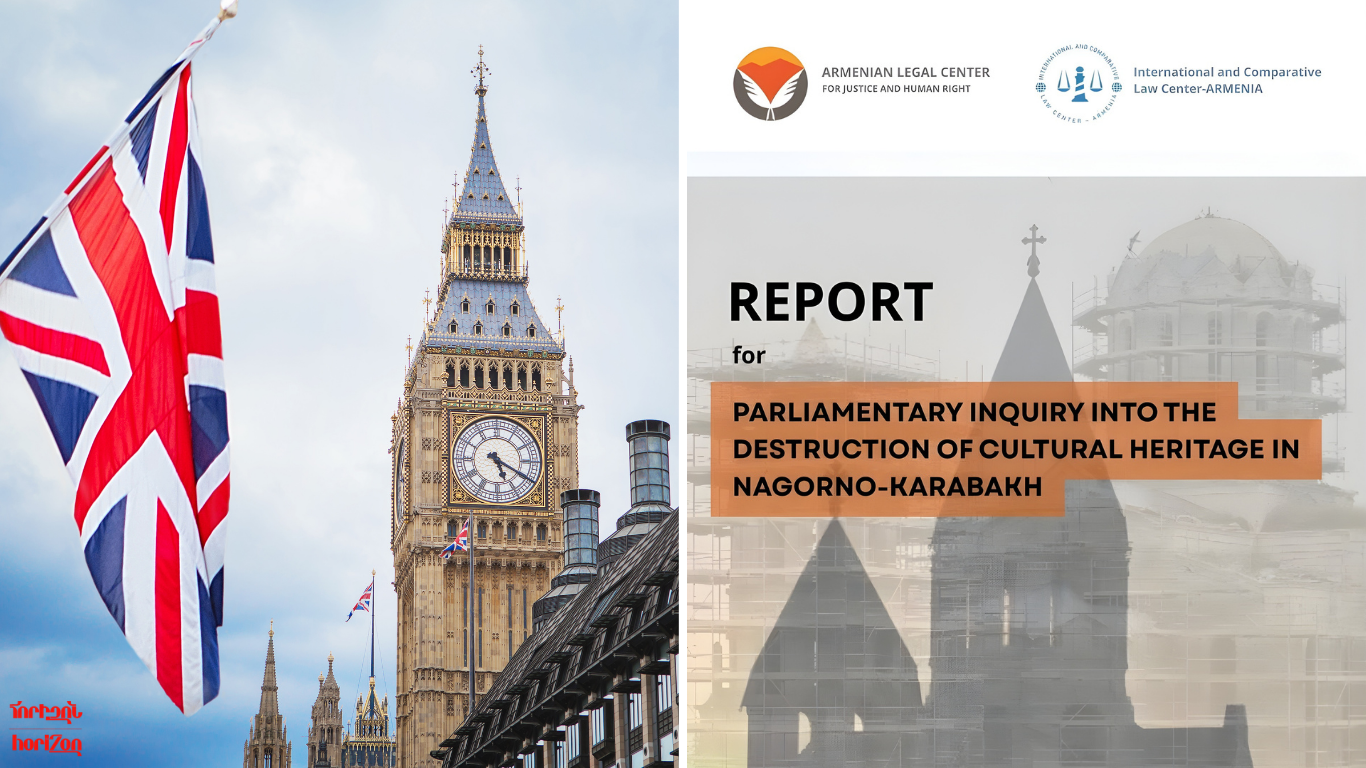
(Horizon Weekly / LONDON) – A report documenting the destruction and alteration of Armenian cultural heritage in Artsakh (Nagorno Karabakh) has been submitted to the British Parliament by the Center for International and Comparative Law in collaboration with the Armenian Legal Center for Justice and Human Rights.
The submission was made as part of an inquiry organized by the International Bar Association’s Human Rights Institute and held at the British Parliament in January and February 2026. The inquiry is being conducted jointly with the All-Party Parliamentary Group on International Law, Justice and Accountability and the All-Party Parliamentary Group on Armenia.
The report outlines numerous cases of destruction, alteration, and appropriation of Armenian religious and cultural monuments in Artsakh, particularly following the 2020 war and the September 2023 Azerbaijani military offensive that led to the forced displacement of more than 100,000 Armenians from the region.
Among the examples cited are the repeated bombing of the Ghazanchetsots Cathedral during the 2020 war and subsequent structural alterations carried out after Shushi came under Azerbaijani control, including the removal of key Armenian religious symbols. The report also documents the destruction of the St. John the Baptist Church (Kanach Zham) after the war, along with attempts by Azerbaijani officials to deny its Armenian identity.
Other documented cases include damage to the Vankasar Church, where Armenian inscriptions and Christian symbols were removed, and the complete demolition of the St. Hambardzum Church. Satellite imagery has also revealed extensive destruction in Armenian villages such as Mokhrenes and Karin Tak.
According to the Center’s research, numerous churches, monasteries, cemeteries, monuments, and historic settlements have been vandalized, structurally altered, or destroyed since 2021. The findings are based on high resolution satellite imagery, open source verification methods, expert consultations, analysis of official Azerbaijani statements, and testimonies from displaced residents.
The report also highlights that forcibly displaced Artsakh Armenians have been deprived of access to their cultural and religious sites, including family graves, preventing them from carrying out traditional memorial and mourning practices.
The authors stress that international law places clear obligations on states to protect cultural heritage during armed conflict. The report references the 1954 Hague Convention for the Protection of Cultural Property in the Event of Armed Conflict, noting that the destruction or deliberate alteration of cultural monuments may entail both state responsibility and individual criminal liability under international law.
The report further emphasizes that the lack of access to Nagorno Karabakh for independent international monitoring missions remains a major obstacle to fully assessing the condition of Armenian cultural heritage in the region.
Calling for a coordinated international response, the report urges the deployment of independent experts to monitor heritage sites and stresses the need to protect the cultural rights of displaced Artsakh Armenians. The Center for International and Comparative Law stated that it will continue its documentation and legal analysis efforts to support the preservation of Armenian cultural heritage and to advance mechanisms of accountability under international law.















Subscribe to our newsletter
