Tigranashen’s future at the centre of political debate
- (0)
By Hasmik Baleyan
Tigranashen is an integral part of the sovereign territory of the Republic of Armenia. The future of this historic Armenian settlement carries considerable historical, political and strategic significance, with important implications for the country’s security. At the heart of the debate are questions concerning Armenia’s territorial integrity, the security of its borders and the preservation of vital transport links with its southern regions.
Tigranashen’s historical ties to Armenia are reflected in maps dating from different periods. Notably, a map prepared by the Foreign Ministry of the Azerbaijan Democratic Republic and presented at the 1919 Paris Peace Conference placed the settlement within Armenian territory. Several maps from the 1920s likewise depicted Tigranashen within Armenia’s borders.
During the Soviet era, changes to Tigranashen’s administrative status led to its designation as an Azerbaijani enclave on certain maps. By 1939, a physical map of the Armenian Soviet Socialist Republic already depicted the settlement as such.
Prime Minister Nikol Pashinyan, who refers to Tigranashen as “Kyarki,” has cited these Soviet-era maps to justify his position on the settlement’s status. His argument is closely tied to the Armenian government’s proposed approach to resolving the broader question of enclaves.
On September 11, 2026, Pashinyan stated that the Soviet-era enclaves were not included in Armenia’s internationally recognized territory of 29,743 square kilometres, whereas Artsvashen was included. He also acknowledged that Armenia and Azerbaijan had yet to reach an agreement on how the enclave issue would be resolved in practice.
These statements, however, do not diminish Tigranashen’s historical significance to Armenia or change the fact that the settlement remains under Armenian sovereign control and forms an integral part of the country’s territorial integrity.
In the early 1990s, as the Armenian-Azerbaijani conflict intensified, Tigranashen came under the control of Armenian forces. It bears repeating that the settlement is part of Armenia’s sovereign and internationally recognized territory.
What is the Armenian government proposing?
The question of Tigranashen’s future has once again come to the forefront of political debate following statements concerning border delimitation and possible territorial arrangements between Armenia and Azerbaijan.
On October 14, 2026, Prime Minister Nikol Pashinyan outlined his proposal for resolving the issue of enclaves and exclaves. Under the proposed arrangement, the two countries would exchange territories of equivalent size, eliminating enclaves and exclaves along their shared border.
The following day, Pashinyan specifically addressed Tigranashen, Artsvashen, which lies within Azerbaijani territory, and settlements in Armenia’s Tavush province that remain under Azerbaijani control.
On October 16, National Security Council Secretary Alen Simonyan presented one possible arrangement under which Tigranashen would remain under Armenian control, while Artsvashen would remain under Azerbaijani control.
Such an arrangement would also require consideration of the relative sizes of the territories involved. According to preliminary figures presented by Simonyan, Artsvashen covers approximately 38–40 square kilometres, while Tigranashen, Verin Voskepar and Sofulu-Barkhudarlu together cover approximately 44–46 square kilometres.
These discussions, however, have yet to produce an agreement between the two sides. Deputy Prime Minister Mher Grigoryan has also confirmed that no final understanding has been reached on the enclave issue.
Opposition concerns
The Armenian opposition has also expressed concerns about the possibility of changes to Tigranashen’s status.
On September 22, 2026, Ishkhan Saghatelyan, a member of parliament representing the opposition Armenia Alliance, warned that, in his assessment, the authorities were preparing to make concessions in Tavush province even before addressing the question of Tigranashen.
Saghatelyan argued that unilateral concessions would not put an end to Azerbaijan’s demands but could instead encourage further claims. He also maintained that ceding Tigranashen would increase, rather than reduce, the risk of another war.
His statements reflect the opposition’s differing approach to border settlements and territorial concessions, highlighting its concerns over the government’s handling of these issues.
Tigranashen’s strategic importance for transportation
Tigranashen’s significance extends beyond questions of territorial status. The settlement also occupies a strategically important position within Armenia’s transportation network.
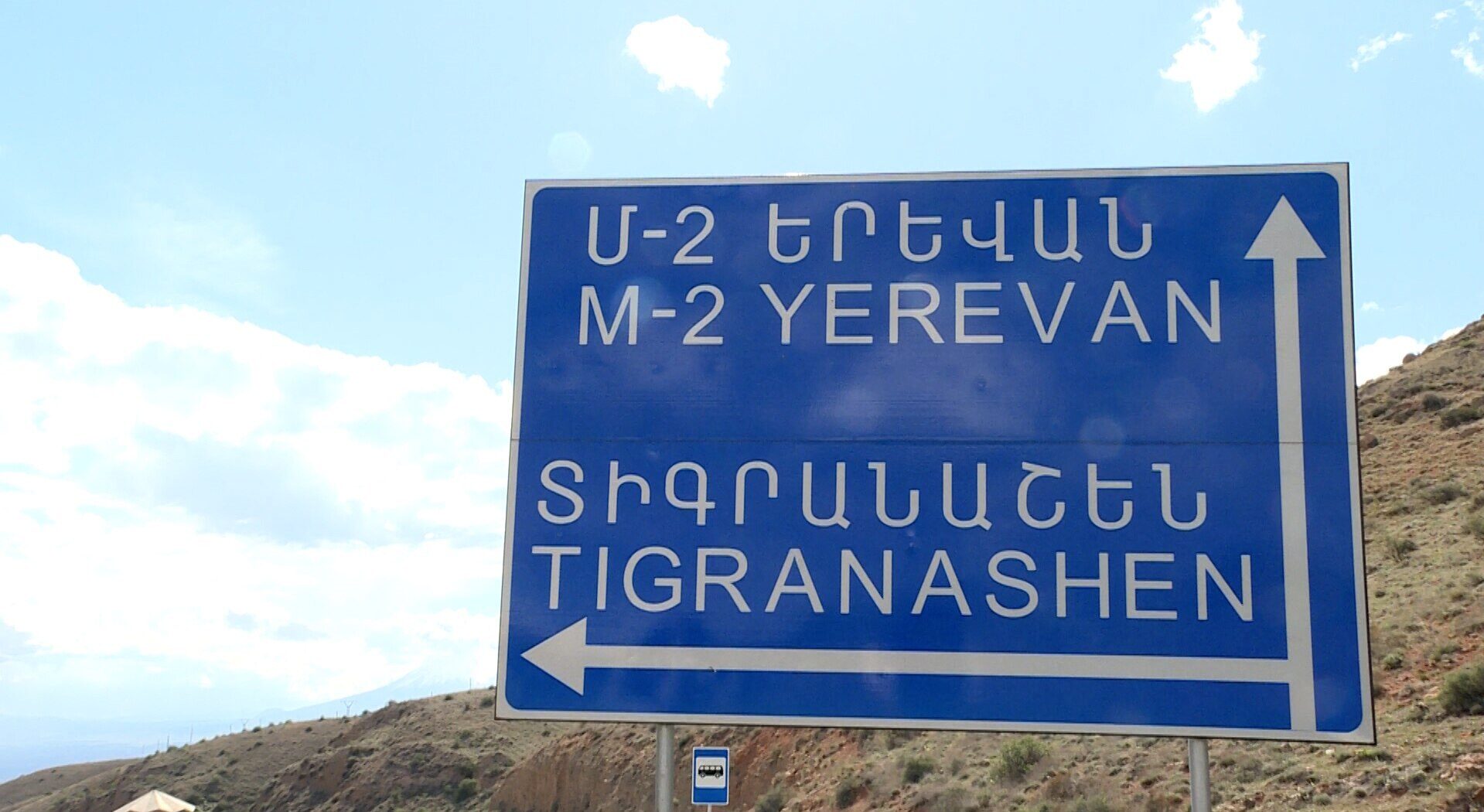
Approximately 4.6 kilometres of the M-2 interstate highway pass through Tigranashen. This major route connects Yerevan with the southern provinces of Vayots Dzor and Syunik and serves as a vital transport link with Iran.
Any change to the settlement’s status must therefore be considered in light of its potential impact on the uninterrupted operation of the highway, Armenia’s access to its southern provinces and the free movement of its population.
An alternative route through Vedi and Lanjar also exists, with repair work underway along certain sections. Its availability, however, does not necessarily mean that it can fully replace the M-2 highway. The viability of this alternative depends on its technical condition, traffic capacity and the adequacy of its supporting infrastructure.
TRIPP and the broader question of regional connectivity
The debate over Tigranashen is taking place alongside broader efforts to reopen transport and communication links across the region.
One initiative attracting particular attention is the Trump Route for International Peace and Prosperity (TRIPP), which envisages establishing a transport connection between Azerbaijan and Nakhichevan through Armenia’s southern Syunik province.
Tigranashen, however, is located in Ararat province and does not fall along the proposed TRIPP route. Moreover, publicly available documents contain no provision making a change to Tigranashen’s status a prerequisite for the project’s implementation.
Although both issues form part of the wider discussions on regional connectivity and Armenian-Azerbaijani relations, they remain separate questions and should be considered as such.
Armenia’s official position is that regional transport links must operate with full respect for the sovereignty, territorial integrity and jurisdiction of the countries concerned. This principle is equally relevant to discussions about Tigranashen’s future.
Tigranashen and Armenia’s territorial integrity
The question of Tigranashen cannot be reduced to a comparison of territorial areas or possible land exchanges.
Tigranashen is an integral part of the sovereign territory of the Republic of Armenia. Any border settlement must therefore be assessed in light of Armenia’s national interests and the need to safeguard its sovereignty, security and territorial integrity.
The future status of this historically Armenian settlement is closely tied to the continued operation of the M-2 interstate highway and the preservation of Armenia’s strategic connection with Iran. It also has important implications for the defence of the Ararat plain and the southern approaches to the capital, Yerevan.
Beyond these strategic considerations, the Armenian state has a moral and legal responsibility to protect the rights of Tigranashen’s residents and ensure that they are not subjected to further displacement.
Ultimately, the outcome of negotiations over Tigranashen will also help determine whether a lasting peace between Armenia and Azerbaijan can be achieved without compromising Armenia’s vital security interests and strategic defences.