
Opposition firmly rejects Pashinyan’s new constitution, denouncing it as an imposition dictated by Aliyev
- (0)
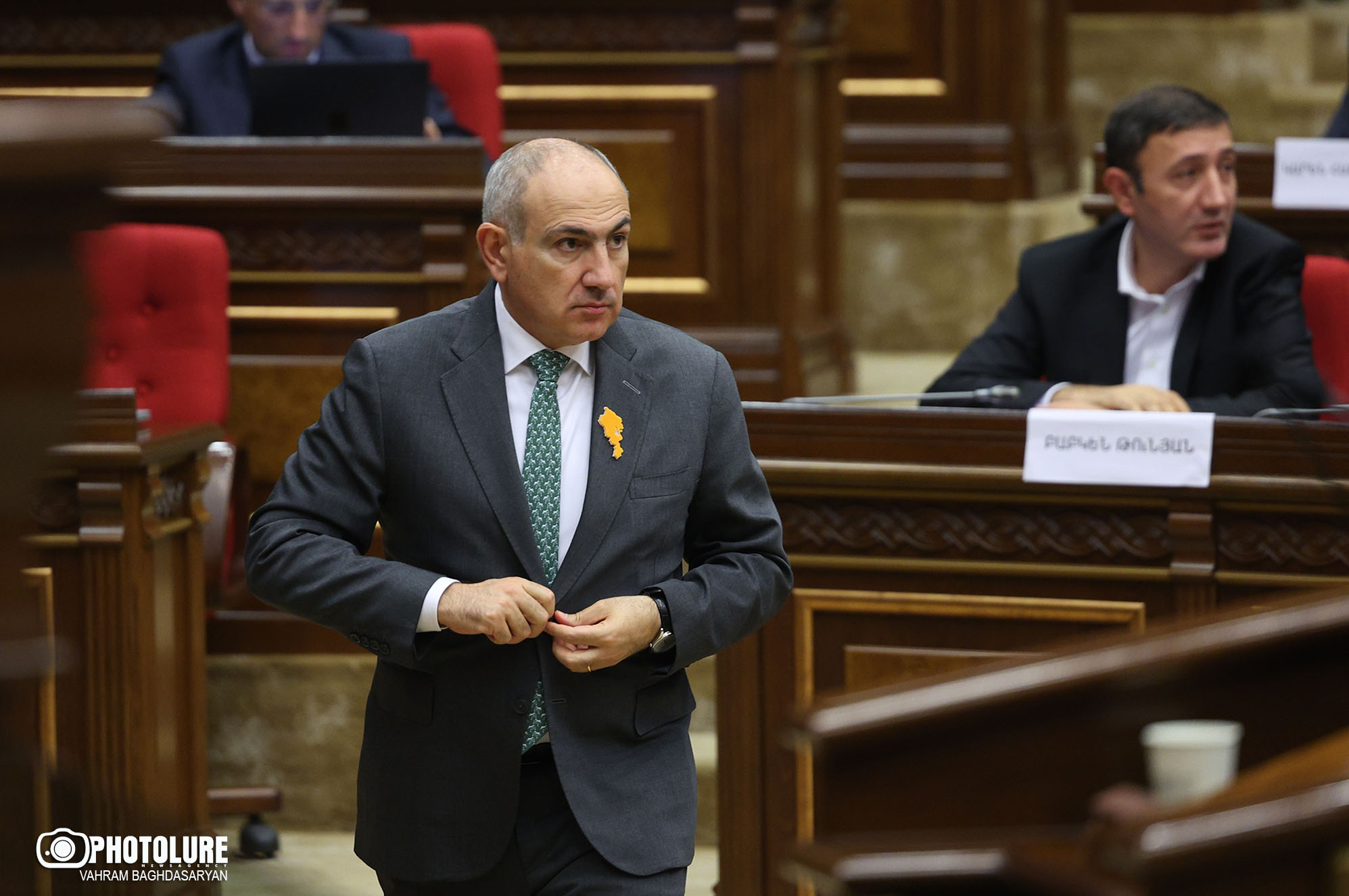
Beyond removing the reference to the Declaration of Independence, the draft proposes controversial changes to national symbols, voting rights and the judiciary. Baku has already welcomed the move.
YEREVAN— Armenia’s two parliamentary opposition factions, Armenia Alliance and Strong Armenia, firmly rejected Prime Minister Nikol Pashinyan’s proposed new constitution on Monday, November 23, refusing to support his efforts to secure the parliamentary votes needed to put the document to a referendum. Opposition leaders condemned the draft as an attempt to undermine the national and historical foundations of Armenian statehood, accommodate Azerbaijan’s demands and consolidate the government’s hold on power. They expressed particular concern over the removal of the reference to the Declaration of Independence, alongside proposed restrictions affecting political and civil rights.
The most contentious change in the draft, published by the Ministry of Justice, concerns the constitution’s preamble. The current constitution begins with the words “The Armenian People” and draws upon the fundamental principles of Armenian statehood and national aspirations enshrined in the 1990 Declaration of Independence. The new draft removes that reference entirely, replacing the opening with “We, the People of the Republic of Armenia” and emphasizing the goal of building an independent, peaceful and prosperous state within Armenia’s internationally recognized borders.
The change directly addresses a longstanding demand from Baku. Armenia’s Declaration of Independence explicitly invokes the December 1, 1989, decision on the reunification of Soviet Armenia and Nagorno-Karabakh and affirms Armenia’s commitment to supporting international recognition of the Armenian Genocide. Azerbaijan has repeatedly demanded the removal of the constitutional reference to the declaration, portraying it as evidence of Armenian territorial claims. Although the proposed constitution does not repeal the Declaration of Independence itself, it would sever the explicit constitutional link to that founding document and the national objectives it embodies.
The political significance of the change became even more apparent when Azerbaijani Foreign Minister Jeyhun Bayramov welcomed the draft on Monday, declaring that Baku “highly appreciates” the absence of what it considers territorial claims against Azerbaijan. Bayramov reiterated that satisfying Azerbaijan’s constitutional demand remains a principal condition for the final signing of a peace agreement. His remarks reinforced opposition concerns that Armenia’s founding legal document is being rewritten under external pressure and in response to Azerbaijani demands.
Ishkhan Saghatelyan, representative of the Armenian Revolutionary Federation’s Supreme Council of Armenia and a member of the Armenia Alliance parliamentary faction, strongly challenged Pashinyan’s portrayal of the Declaration of Independence as an obstacle to peace. He noted that Article 2 of the already initialled peace agreement rules out mutual territorial claims, while Article 7 prevents either party from invoking domestic legislation as justification for failing to fulfil its obligations under the agreement. Saghatelyan also recalled the Armenian Constitutional Court’s position that provisions of the Declaration of Independence not explicitly incorporated into the constitution do not carry independent constitutional force. He argued that portraying the declaration as an obstacle to peace serves Aliyev’s political agenda, aimed at humiliating the Armenian people and legitimizing Azerbaijan’s actions.
Armenia Alliance parliamentary secretary Artur Khachatryan likewise declared that the opposition would reject Pashinyan’s proposal and had no intention of entering negotiations with the government on the issue. Tigran Abrahamyan, secretary of the Strong Armenia faction, went further, describing the document as an “Aliyev constitution” and warning that it contains undemocratic and authoritarian provisions. Abrahamyan specifically criticized replacing the term “Armenian people” with “people of the Republic of Armenia,” stressing that Armenia’s constitution must never be adopted at the demand of a foreign government.
A closer examination of the draft reveals that the proposed changes extend well beyond the Declaration of Independence. The existing constitutional descriptions of Armenia’s national flag and coat of arms would also be removed. As a result, explicit references to Mount Ararat, Noah’s Ark and the emblems of Armenia’s four historical kingdoms would no longer appear in the constitutional text. The draft would retain the flag, coat of arms and anthem as national symbols, but their descriptions and specifications would instead be determined by a separate law adopted through a referendum.
The proposed constitution also introduces significant changes to citizenship and electoral rights. Article 20 would make participation in parliamentary elections and referendums conditional upon having permanently resided in Armenia for at least one year during the two years preceding a vote. Such a requirement could disenfranchise substantial numbers of Armenian citizens living abroad. Meanwhile, Article 24 would permit the revocation of citizenship by court order for certain criminal offences, in contrast to the current constitution, which explicitly prohibits depriving an Armenian citizen of citizenship.
Proposed changes to the judiciary have raised equally serious concerns. Under the draft, sitting judges, with the exception of Constitutional Court members, would undergo a one-time reassessment over a five-year period. Until that process is completed, they would continue serving as acting judges. The reassessments would be conducted by a commission elected by the parliamentary majority. At the same time, all 10 members of the Supreme Judicial Council would be elected by parliament, whereas the current system allows half of its members to be elected by the general assembly of judges. These measures raise fundamental questions about judicial independence and the potential expansion of political influence over the courts.
The draft also proposes substantial changes to Armenia’s political system. It would allow political parties receiving foreign funding or advocating the surrender of Armenia’s independence to be banned by Constitutional Court ruling. Parliament would gain the authority to dissolve itself with a three-fifths majority, while the parliamentary threshold required to call a constitutional referendum would be reduced from two-thirds to three-fifths. The prime minister would also become supreme commander of the armed forces during peacetime, rather than only during war. Although the proposal includes certain provisions presented as strengthening parliamentary oversight and opposition representation, the overall package raises serious concerns about checks and balances, political pluralism and the concentration of executive power.
Garnik Danielyan, a member of the ARF Supreme Council of Armenia, also rejected the constitutional initiative, insisting that Armenia’s supreme legal document must not become an instrument for fulfilling Aliyev’s demands. He drew attention not only to the proposed revision of the country’s national and historical foundations, but also to potential threats involving judicial independence, political party activity, citizenship revocation and government oversight of the media. Fellow Armenia Alliance lawmaker and ARF member Kristine Vardanyan similarly criticized the provisions concerning voting restrictions, judicial reassessments and the banning of political parties, warning that they could place additional instruments of political control in the hands of the government.
In his public address, Pashinyan defended the proposal, arguing that a new constitution would strengthen Armenia’s sovereignty, secure lasting peace and establish the foundation of what he calls the “Fourth Republic.” He portrayed the 1990 Declaration of Independence as a document rooted in the logic of conflict and maintained that adopting a new constitution would make it possible to sign and ratify the peace agreement with Azerbaijan, paving the way for lasting and irreversible peace. Yet those assurances leave a central question unanswered: Why should the revision of Armenia’s founding constitutional principles be conditioned on demands from Baku, particularly when the draft peace agreement already contains provisions ruling out mutual territorial claims?
The initiative also faces a significant parliamentary obstacle. In the June 2026 elections, Pashinyan’s Civil Contract party secured 64 seats, while the current constitution requires at least 70 votes to submit a new constitution to a referendum. Pashinyan has consequently appealed to opposition lawmakers to provide the six additional votes, promising to resign if voters reject the proposed constitution and, if it passes, not to seek another term as prime minister in the next elections. Both opposition factions have rejected the offer, reiterating that they will not participate in what they consider a constitution-making process driven by external pressure.
The document remains a preliminary draft, subject to public consultations and possible revisions. Nevertheless, the constitutional initiative has already emerged as one of Armenia’s most consequential political confrontations. The opposition’s rejection reflects a fundamental position: Whatever the merits of constitutional reform, it cannot justify revisiting the historical foundations of Armenian independence, abandoning national aspirations or weakening fundamental rights in order to accommodate Azerbaijan’s demands.