Armenia’s Central Bank warns of economic risks amid export restrictions
- (0)

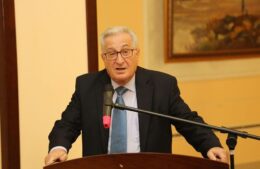
(Horizon Media / YEREVAN) – Central Bank Governor Martin Galstyan has warned that restrictions on Armenian exports could create short-term economic pressures, including deflationary risks and possible exchange-rate fluctuations.
Speaking at a press conference, Galstyan said the Central Bank is assessing the possible impact of the current trade restrictions on Armenia’s economy. He noted that a significant decline in exports, if not offset by other components of the balance of payments, could place pressure on the Armenian dram.
“The embargo creates deflationary risks. If exports fall sharply and this is not balanced by other inflows, it may affect the exchange rate of the dram,” Galstyan said, adding that the Central Bank is also considering the broader short-term consequences of the restrictions and possible economic sanctions.
Galstyan also addressed the situation facing farmers, saying the Central Bank is looking at possible support mechanisms for those with outstanding loan obligations. He stressed, however, that no agreement has yet been reached with banks.
“At this stage, discussions must first be held with our government partners, after which talks with the banks can begin,” he said. “We have gone through similar processes before, including during the pandemic and the war. The support programs would not be new in their nature.”
The Central Bank governor also pointed to energy prices as another possible factor affecting inflation. He said that any sudden increase in gas prices would naturally push inflation higher and could have secondary economic effects.
Russia introduced restrictions and bans on the import of several Armenian goods ahead of Armenia’s June 7 parliamentary elections. Moscow has cited phytosanitary concerns as the reason for the measures. The restrictions have pushed Armenian exporters to look for alternative markets, including in the European Union.
The EU has announced support measures for Armenia in response to the situation. European Commission President Ursula von der Leyen said that the EU would provide more than €50 million in immediate assistance, along with additional measures to facilitate trade and expand export opportunities for Armenian goods.
The latest developments also highlight Armenia’s increasingly difficult position between Russia and the European Union. While Moscow’s restrictions have added pressure on Armenian producers and exporters, the EU’s response also reflects its own wider strategic competition with Russia in the region. As a result, Armenia once again finds itself caught in a broader geopolitical confrontation in which both sides seek to advance their interests, often with little regard for the economic and social consequences for the Armenian public.
EU officials have described Russia’s actions as a form of economic pressure, while Russian authorities maintain that the measures are linked to food safety and phytosanitary standards.