
October 06, 2026
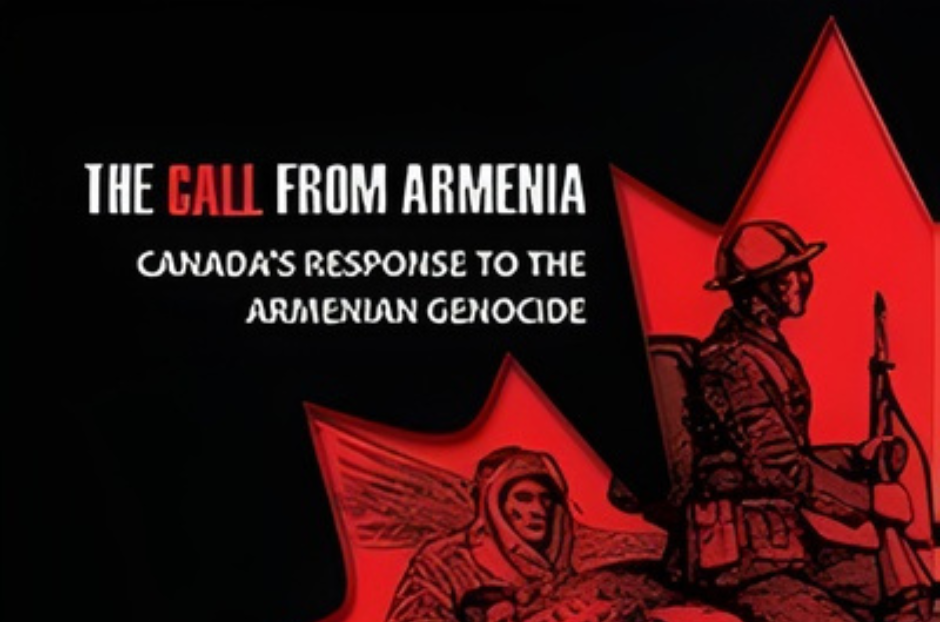
Armine Muqoyan sat down for a conversation with historian Aram Adjemian, author of The Call from Armenia: Canada’s Response to the Armenian Genocide. Based on his groundbreaking research, Adjemian explores a largely overlooked chapter of history—Canada’s humanitarian, political, and societal responses to the Armenian Genocide.
Drawing on archival discoveries and historical analysis, he sheds light on the motivations behind Canada’s engagement, the limits of its actions, and the broader implications for understanding humanitarianism in times of crisis. This conversation offers valuable insights into how memory, identity, and historical responsibility continue to shape discussions around genocide and international response today.
AM: What inspired you to write specifically about Canada’s response to the Armenian Genocide, a topic that has been little studied?
Aram Adjemian: First off, thank you for providing me with this opportunity to revisit my research, originally an M.A. thesis which I had the opportunity to enhance and publish in book form to commemorate the centenary of the Armenian Genocide in 2015. The answer to your question is contained, in part, within it: my main motivation was the very fact that so little of this slice of history had previously been studied.
While a Master’s student in History at Concordia University specializing in human rights and genocide studies, I was sifting through a 1985 two-volume compendium of articles related to the Armenian Genocide, prepared by Montreal’s Yeridasartats (A.R.F. Youth) and published by the Armenian National Committee of Canada. I came across a short news article titled something like “Canada to take the Mandate for Armenia.” The story of the American “Wilsonian” mandate for Armenia was relatively well known, but I had not up to that point heard anything about Canada’s specific interest or involvement: my curiosity was piqued. Being a Canadian-Armenian and aspiring genocide historian, I thought that this particular topic would be a great fit for my dissertation.
AM: What symbolic meaning does the title of the book, The Call from Armenia, have?
Aram Adjemian: The notion of responding by “hearing the call” has religious overtones in western English-speaking cultures. Several publications I came across related this idea of serving on behalf of the “martyred” Armenian people by responding to this divine “call” to duty. The Globe newspaper launched a large fundraising campaign on January 9, 1920 with that very title, The Call From Armenia, to raise funds to help the Armenian people. I felt that it was a fitting title for this book.
AM: During your research, what fact or archival material surprised you the most?
Aram Adjemian: Personally, the most satisfying part of doing this historical research was the detective work, of uncovering hidden and unexpected facts.
First, I’ll go back to the idea of a Canadian mandate for Armenia. The very notion that there was talk in Canada to consider taking on an expensive, difficult and unrealistic mandate to allow for the country of Armenia to exist, was hard to understand at first. Canada had just started to flex its independence muscles following their sacrifices and increased international role during the First World War. Still, such a mandate had been estimated by an American fact-finding mission to cost $750 million dollars over 5 years and require 60,000 soldiers. The rest of my book is essentially an attempt to explain why this was ever contemplated in Canada.
The graphic newspaper illustrations I came across were also striking. These include detailed illustrations of Aurora Mardiganian’s incredible and by now well-known story of survival, published as a special series in the Winnipeg Evening Tribune in 1918. These were eventually published in book form as Ravished Armenia, which was later turned into the motion picture Auction of Souls (disturbingly, Aurora portrays herself in the movie). Or, one that was published in The Globe (originally published in New York World) a week after the Ottoman Empire joined the war on the side of Germany and the Central Powers, portraying a Turkish person sharpening his sword in preparation for renewed massacres, with the caption “I, too, must do something for culture”. This prescient illustration was published 6 months before April 24, 1915.
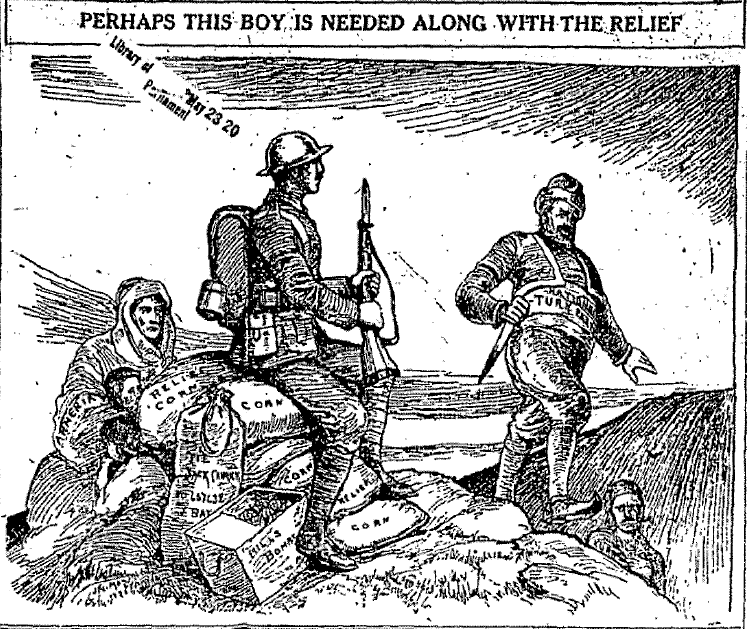
In relation to my specific research, the most interesting of these illustrations was published at the height of Canadian interest in the Armenian issue, on the front page of The Globe on February 25, 1920. Canadian soldier “Jack Canuck”, rifle at the ready and sitting on munitions and relief supplies, is protecting an Armenian woman and her two children from a member of the “National Turk Party” holding a bloodied knife, with the caption “Perhaps This Boy Is Needed Along With The Relief”. This powerful image demonstrates how strongly The Globe’s editorial board felt about the issue.
One last item of interest: a picture of a “Canadian Hospital” was published in December 1920. A good portion of the money raised by The Globe’s campaign was used to purchase and run the building, which had been inaugurated on Canada Day (July 1), 1920. It served as an orphanage, to treat tubercular children, and also to treat wounded soldiers. Interestingly, I was able to locate the building, which still stands—and remarkably, is still a hospital (the Yedikule Chest Diseases and Thoracic Surgery Training and Research Hospital). Nowhere else are the origins of the building remembered or commemorated, as far as I know.
AM: How would you describe the attitude of Canadian society towards Armenians between 1915 and 1923?
Aram Adjemian: Allow me to go back in time a few decades to answer that question, to the 1880s, when Canadian missionaries were first stationed among the American Board of Commissioners for Foreign Missions (ABCFM). These missionaries witnessed and related what had been happening to the Armenian people to Canadian newspapers and religious magazines, several of which are reproduced in the book. Some of them provided eyewitness testimony of killings during the Hamidian massacres of 1895-96 and the Adana Massacres of 1909. As such, a segment of mainly Protestant Canadians had been reading about, and in some cases agitating for, the Armenian people from quite early on.
Since Canada was at war with the Ottoman Empire in 1915, Canadian missionaries had been forced to leave the country. As a result, there was no longer a pipeline of information emanating from purely Canadian sources during the Genocide itself. Contrast this to American missionaries and diplomats who were allowed to remain because the U.S. had never declared war on the Ottoman Empire, and from whom we have such important first-hand eyewitness accounts, including those of Ambassador Henry Morgenthau and Dr. Clarence D. Ussher.
Nevertheless, the seeds of interest had been sown early on in Canada. After the War, and especially when the Turkish Peace Treaty was being negotiated in late 1919 and early 1920, a huge grassroots humanitarian campaign took hold and led to the phenomenal response which I describe in detail in Chapter 3 of the book.
AM: Your book mentions that there was a large humanitarian movement in Canada to help Armenians. Why was there such a large response?
Aram Adjemian: The large-scale humanitarian interest and intervention in 1920 is rooted in those four decades of information flowing home from Canadian missionaries being stationed in the Ottoman Empire. Missionaries such as Frederick MacCallum and brothers William and Robert Chambers lived there for decades: they wrote home about what they were witnessing, pleading for more to be done to aid in Armenian relief efforts. Following the Hamidian massacres in 1895-96, there was vast media coverage in several Canadian newspapers and magazines, tens of thousands of dollars had been collected and sent to British relief associations for distribution among the Armenians, and the House of Commons was petitioned to make an appeal to Britain to do more on the matter. Newspaper coverage of the Adana massacres in 1909 were also followed by fundraising campaigns and lobbying efforts.
In 1916, the Armenian Relief Fund Association of Canada was formed to better coordinate Canadian relief efforts. Around $300,000 was collected and distributed for Armenian relief between 1918 and 1920 (such posters were used in their campaigns). The year 1920 saw the largest humanitarian interest, along with further fundraising efforts (especially by The Globe’s campaign which raised another $300,000 that year alone) and more sustained lobbying efforts.
AM: What role did Canadian churches and religious organizations play in the Armenian question?
Aram Adjemian: Some mainly Ontario-based Protestant churches and religious organizations, and Universities as well, had shown great interest in the plight of the Armenians from the 1890s onward. My 4th chapter details how this coincides with the Social Gospel movement in Canada, a Protestant-led reform effort that sought to apply Christian ethics to social problems arising from industrialization. Many of the leaders of this movement, such as Queen’s University Principal George Munro Grant, became staunch supporters of the Armenian people, thus applying Social Gospel concepts to those outside Canada’s borders as well, in this particular case at any rate. As mentioned earlier, relief efforts had a tenor of religious obligation to them, their “call for duty” representing divine service for the suffering Christian Armenians. As such, these and many other religious organizations across Canada wrote protest letters to the federal government in 1920.
AM: How prepared was the Canadian government to undertake political action, not just humanitarian aid?
The Canadian government in 1920 responded to the lobbying efforts. It exerted diplomatic pressure with the Allied Powers and especially the British Government during Turkish Peace Treaty negotiations, which was representing Canada and the rest of the Commonwealth countries. Although Canada didn’t have a seat at that table, acting External Affairs Minister Newton Rowell communicated Canada’s position on the issue with the British government. He stated that Canada wanted to be put on record as absolutely opposed to the return of any of the Armenian provinces in Turkey to Turkish Rule. There were a lot of communiqués going back and forth on the issue between them in early 1920, and I reproduce a good portion of the archival documentary record in the book.
In the end though, the Canadian government was more irked by the fact that Britain was not keeping it aware of Peace Treaty negotiations than anything else. Canadian Foreign Policy enthusiasts might find it interesting that the Canadian government was using this issue, among others, in an effort to push for better representation and information in a bid to augment Canadian sovereignty. Ultimately however, it didn’t do much for a resolution of the Armenian issue.
AM: The book mentions that Canada discussed the idea of a mandate for Armenia. How realistic a possibility was that?
Aram Adjemian: The Canadian Mandate for Armenia had been an idea tossed around intellectual circles, but nothing realistic came of it. That said, the very notion of it being discussed at all is certainly noteworthy.
AM: How would you explain the contradiction that there was sympathy for Armenians in Canada, yet there were also immigration restrictions?
Aram Adjemian: A very interesting question, which gets to the heart of the issue on matters relating to humanitarian interest vs. intervention generally. It would be tempting, if simplistic, to conclude that Canadians merely paid lip service to the Armenian people. Briefly stated, the sudden end to the pronounced Canadian humanitarian interest in 1920 was more an issue of unfortunate timing for the Armenians, with Canadians (as others in many other countries) generally disentangling themselves from the idea of foreign wars, while a resurgent new Turkish Republic was being forged under Kemal Ataturk’s rule.
My research did not focus on Armenian immigration to Canada, the main source to consult on this is Isabel Kaprielian-Churchill’s important 2005 book Like Our Mountains. Other than the limited scope of the Georgetown Boys’ story, where 110 boys and 40 girls were brought to Canada as an immigration experiment, Canada did not accept Armenians as preferred immigrants at the time. They were considered “Asiatics”and thus unsuitable for immigration. Suffice it to say that, other than the stated interest of a few Canadian parliamentarians in 1920, subsequent federal governments showed little interest in the Armenian issue.
I will mention one thing here though: in 1922, the Canadian Parliament authorized the government to make war reparation claims on behalf of some Armenians Canadians, estimated to run in the millions of dollars. Although a Royal Commission was eventually set up in 1930 to deal with these claims, they hardly received any compensation, the Commission citing lack of proof. Still, it is another important fact that should be understood in its proper context.
AM: Why do you think this story has remained in the shadows of Canadian historiography for so many years?
Aram Adjemian: Canada is hardly alone in its lack of production on Armenian Genocide related historiography any earlier. With the annihilation of the Western Armenian nation, and while a newly independant Eastern Armenian nation was absorbed by the Soviet Union, Armenian genocide survivors and orphans barely struggled to make a life for themselves in the various countries they emigrated to. Hardly anyone else advocated for the Armenian people after the 1920s either, the story more or less died with the advent of the Turkish Republic in 1923. In Canada and elsewhere, children were exhorted to eat their vegetables and to think of the Starving Armenians, but that’s about it.
Armenian Genocide historiography began in earnest only as of the 1970s, with more critical analyses being produced in the last few decades. I know of at least two researchers who have produced work similar to mine, which they published at around the same time I did: Vicken Babkenian regarding Australia’s response to the Armenian Genocide, and Heitor Loureiro regarding Brazil’s.
AM: How much impact did this topic have on your personal identity as an Armenian-Canadian?
Aram Adjemian: I am happy and proud to have contributed to both Canadian and Armenian Genocide historiography through my research.
AM: During your research, did you come across any facts that changed your initial perceptions of Canada?
Aram Adjemian: Before launching into this research I was not a specialist on Canadian history generally, nor of that time period specifically. Like many of my generation and upbringing, I had learned that Canada was very interested in peacekeeping activities globally and of human rights issues generally. I believe that interest in the Armenian issue became a catalyst for the country’s stated humanitarian interests internationally. Further research would have to be conducted to make a stronger case for that specific connection, but I think there might be a plausible link. For example, missionary Frederick MacCallum’s daughter Elizabeth MacCallum was Canada’s first woman to head a Canadian mission abroad as a Chargé d’Affaires to Lebanon in 1954, and she was also a major contributor to the plan of resolving the Suez Crisis in 1956, for which Prime Minister Lester B. Pearson won the Nobel Peace Prize. Elizabeth had been born in Marash in 1895, one of many “Mish Kids,” or children of missionaries, to later work in the Canadian foreign service. Just how influenced she and other Canadians were by earlier Armenian relief efforts could be an interesting facet to explore for future historians.
AM: What lesson can today’s world learn from Canada’s response to the Armenian Genocide?
Aram Adjemian: That’s a tough one… Real humanitarian intervention takes time, energy, money, will, and serious moral fortitude. We may believe that we have learned from lessons of the past, we may be willing to help, we may feel horrible hearing about atrocities perpetrated abroad, but none of that means that we, generally, are willing to disrupt our comfort to undertake definitive action. Simply saying “Never Again” doesn’t make it so.
Allow me to offer a current example of this: there is a terrible crisis unfolding as we speak in Sudan, which has been ongoing for decades now. Apart from the millions of people enduring famine, genocidal killings have been unfolding since 2023 around the Darfur region, as it had two decades earlier as well. Canada is sending, at last count, $120 million in humanitarian and relief aid to the region, which is commendable: but this does nothing to stop the violence that is occurring daily. Sound familiar? What are we doing to stop this violence? Who is pressuring the Canadian government to do more than just sending aid? Why is there barely any Canadian (or international) news coverage? These are the questions we as a society might want to ask ourselves. Yes indeed, Canadians were, briefly, very interested in the plight of the Armenian people, and one might argue that this became a stepping stone for this country becoming a beacon of humanitarianism worldwide: but was it enough? If we truly want to learn lessons from the past, we need to be better and more responsible stewards of our shared history.
AM: How do you assess Canada’s current position on the issue of recognizing the Armenian Genocide in historical context?
Aram Adjemian: Canada’s recognition of the Armenian genocide in 2002 (Senate), 2004 (House of Commons) and 2006 (government) is commendable, but considering the country’s involvement and interest in the Armenian people a century earlier, it came rather late. That said, the United States was even more involved and interested in the plight of the Armenian people, yet their recognition happened only very recently, in 2021. And neither of these countries, nor any other country or territory, would have bothered to recognise the Genocide were it not for consistent pressure and lobbying efforts by Armenian communities within those jurisdictions. Justice and historical truth are so often casualties of geopolitical calculations: it is a shame that such recognition efforts are even necessary. We could of course, rightly, point to the Turkish Government’s consistent and systematic anti-genocide recognition campaigns for Canada’s delayed recognition. Better late than never, I suppose, would be my assessment. It could also be said that it was too little, too late.
AM: If the reader could take away only one main idea from the book, what would you want it to be?
Aram Adjemian: As a Canadian-Armenian and aspiring historian, it was very gratifying to have an opportunity to merge so many facets of my identity within this research, and I’m overjoyed to have been able to add a small piece to the Armenian Genocide historiography puzzle. My hope would be for readers of my book (or even readers of this interview) to consider how many in faraway Canada felt a link to those they referred to as their “Christian brethren” over a century ago. Canadians not only donated to Armenian relief campaigns: many “heard the call” and signed up for missionary duty, or travelled abroad to serve as soldiers, or nurses (such as Nova Scotia’s Sara Corning), as a direct result of The Globe’s campaign.
Disturbingly, this same newspaper (under its later iteration, The Globe and Mail) would use denialist language when referring to the issue decades later. Between the 1980s and 2000s, many articles in that newspaper would refer to the “so-called” Armenian Genocide, parroting Turkish minimization and obfuscation of the issue. By doing so, they conflated the often touted concept of “seeing both sides of an issue”, or conducting “balanced journalism”, with reporting things accurately and faithfully. Perhaps another good takeaway from this research would be for Canadians to forcefully continue calling out the ongoing denial of the Armenian Genocide, in all of its forms.
Armine Muqoyan

















Subscribe to our newsletter
