Iran–U.S.–Israel ceasefire shaken within hours as strikes resume
- (0)
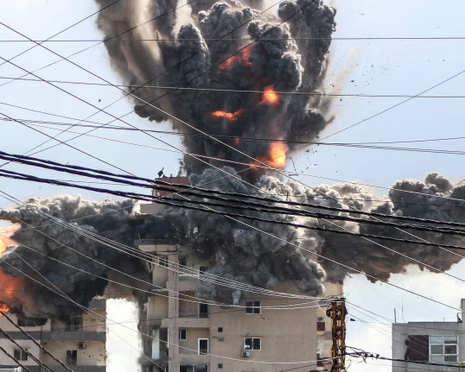
(Horizon Media) – A fragile two-week ceasefire announced between Iran, the United States and Israel is already under strain, with renewed attacks reported just hours after the agreement was unveiled.
The last-minute deal allowed U.S. President Donald Trump to step back from threats of a large-scale bombing campaign against Iran. However, missile and drone activity reported across the Gulf region on Wednesday has raised immediate doubts about whether the ceasefire can hold. U.S. Vice President JD Vance described the agreement as “fragile,” reflecting uncertainty surrounding both its durability and its terms.
Key aspects of the deal remain unclear, with each side presenting different interpretations. Iranian officials indicated that the arrangement could formalize new restrictions in the Strait of Hormuz, including the possibility of charging transit fees to passing vessels. No confirmation has emerged that other countries have accepted such a condition, and it remains uncertain whether commercial shipping would consider the route secure under Iranian oversight.
The situation is equally uncertain in Lebanon, where Hezbollah continues to confront Israeli forces. While mediators, including Pakistan, suggested the ceasefire could extend to that front, Israeli officials rejected that interpretation. Airstrikes were reported in Beirut shortly after the agreement, and Israeli ground operations are ongoing. Hezbollah has not formally committed to the ceasefire, with indications it will not halt attacks unless Israel does the same.
Another major point of ambiguity concerns Iran’s nuclear and missile programs, which were central to U.S. and Israeli war aims. Trump stated that Washington would work to recover enriched uranium buried at sites targeted in recent joint strikes, though Iranian authorities have not confirmed any such arrangement. Conflicting versions of the ceasefire text further complicate the picture: a Farsi version references continued uranium enrichment, while English-language versions omit that language.
Despite sustaining heavy damage from U.S. and Israeli operations, Iran retains leverage through its control over the Strait of Hormuz, a critical artery for global energy supplies. Regional sources suggest the ceasefire could allow Iran, alongside Oman, to impose fees on ships passing through the waterway. Such a move would break with longstanding international practice treating the strait as open to free navigation and is expected to face strong opposition from Gulf states.
Iranian Foreign Minister Abbas Araghchi said transit would remain possible under Iranian military management, adding further uncertainty about future shipping conditions. Even so, initial reports of the ceasefire contributed to a drop in oil prices and a rise in global stock markets.
Meanwhile, Iran’s conditions for a broader settlement reportedly include the withdrawal of U.S. forces from the region, sanctions relief, and the release of frozen assets, demands that remain unlikely to gain broad international support. Trump signalled openness to discussing sanctions and tariffs, though no concrete commitments have been confirmed.
The hours following the announcement underscored the volatility of the situation. Missile alerts were issued across several Gulf states, including Bahrain, Saudi Arabia, Kuwait and the United Arab Emirates. An oil facility on Iran’s Lavan Island was struck, while regional air defences intercepted incoming missiles and drones. Responsibility for some of the attacks remains unclear.
Casualty figures from the conflict continue to mount. Thousands have been killed across Iran and Lebanon, with mass displacement reported in both countries. Dozens of deaths have also been recorded in Israel, the occupied West Bank and Gulf states, alongside U.S. military casualties.
Public reaction inside Iran highlights the domestic pressures facing the leadership. Demonstrations in Tehran following the ceasefire announcement featured chants against the United States and Israel, underscoring the continued influence of hardline factions and the uncertain political environment surrounding any de-escalation.
With core issues unresolved and hostilities persisting on multiple fronts, the agreement appears less a durable settlement than a temporary pause in a broader and still unsettled conflict.