International law, power politics, and the politics of blame: A critical reading of Aliyev’s latest remarks
- (0)
By Horizon staff writer
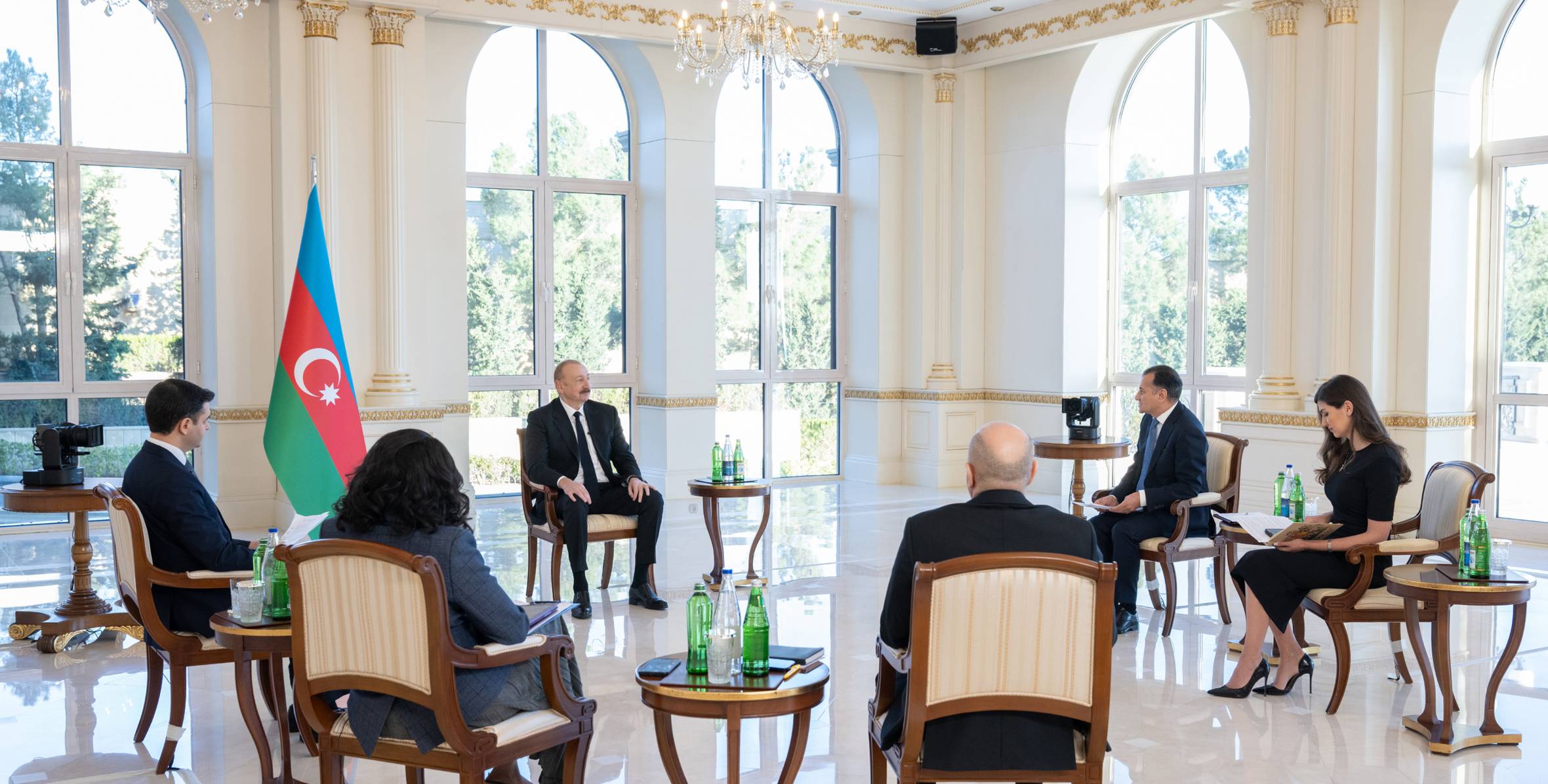
In a recent interview broadcast by Azerbaijani state television on January 5, President Ilham Aliyev offered a revealing account of how his government understands war, peace, and international relations in the South Caucasus. While framed as a reflection on regional realities, Aliyev’s remarks go far beyond commentary. They articulate a worldview in which power replaces law, accountability is displaced by triumphalism, and responsibility for ongoing tensions is shifted outward rather than confronted directly.
Aliyev’s assertion that international law has effectively ceased to exist and that only power, alliances, and leverage now matter is among the most striking elements of the interview. Presented as a blunt acknowledgement of reality, this claim is in fact a repudiation of the very principles that underpin the international system to which Azerbaijan itself formally subscribes. International law is not an abstract ideal invoked only by weaker states. It is the framework that governs borders, sovereignty, civilian protection, and post-conflict obligations. Declaring it obsolete does not make it disappear. It instead signals an intent to operate beyond constraint while still benefiting from the legitimacy that legal recognition provides.
This framing is especially troubling given the context in which it is delivered. The South Caucasus is not emerging from a negotiated settlement but from a sequence of wars concluded by force. To suggest that law no longer applies is to normalize outcomes achieved through coercion while foreclosing avenues for accountability, restitution, or reconciliation. For Armenia and for Armenians displaced from Artsakh, international law remains the only viable language through which rights can be articulated and grievances addressed. Dismissing it does not resolve the conflict. It merely entrenches its asymmetries.
Aliyev’s declaration that the war with Armenia has now ended politically follows the same logic. Peace, in this account, can be declared unilaterally once strategic objectives are achieved. Absent from this narrative is any serious engagement with unresolved issues that continue to define the conflict’s aftermath, including security guarantees, border arrangements, the fate of hostages, and the protection of cultural and religious heritage. A peace declared in the absence of these elements is not reconciliation. It is a consolidation of victory.
The interview also devotes significant attention to external actors, particularly the Armenian diaspora in the United States. Aliyev repeatedly attributes diplomatic obstacles, including long-standing restrictions in US-Azerbaijan relations, to what he describes as the influence of the Armenian lobby. This claim is neither new nor accidental. It functions as a political device that recasts policy disagreements and human rights concerns as the product of ethnic manipulation rather than democratic debate.
Such rhetoric ignores a fundamental reality of pluralistic societies. Armenian diaspora advocacy operates within the same legal and civic frameworks as other interest groups. It reflects sustained concern over issues that are well documented, including the use of force, displacement of civilians, and the erosion of negotiated conflict resolution mechanisms. Portraying this advocacy as sabotage is to dismiss legitimate scrutiny and deflect attention from Azerbaijan’s own record and choices.
More broadly, the interview reinforces a familiar pattern in Aliyev’s public discourse, one that relies on moral absolutism and historical vindication rather than self examination. Power is presented not merely as a tool but as a justification. Diplomatic success is measured by leverage rather than legitimacy. Opposition, whether from Armenia or from international civil society, is framed as hostility rather than engagement.
What is notably absent from this account is any recognition of the human dimension of the conflict as experienced by Armenians. There is no acknowledgement of displacement, loss, or the long-term consequences of a peace imposed through force. The silence is not incidental. It reflects a conception of order in which stability is achieved by erasing inconvenient narratives rather than integrating them into a shared future.
Aliyev’s interview, therefore, offers less a roadmap to peace than a declaration of how Azerbaijan intends to interpret the post-war order. It is an order rooted in power politics, insulated from accountability, and sustained by the externalization of blame. For Armenia, and for those invested in a durable and just peace, this underscores a central challenge. Reconciliation cannot be built on the denial of law, nor can stability endure when peace is treated as a trophy rather than a process.
In the end, the question is not whether power matters. It always has. The question is whether power is exercised within a framework that restrains excess, protects rights, and leaves room for coexistence. On that measure, Aliyev’s remarks raise more concerns than they resolve.