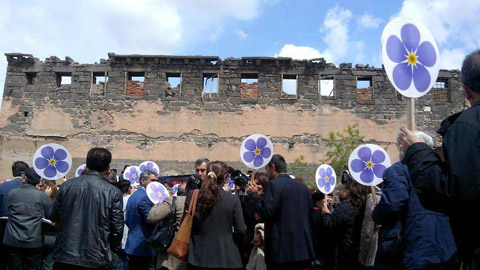
Outside the Surp Sarkis Armenian church, DiyarbakirPhoto: Fréderike Geerdink
By FRÉDERIKE GEERDINK
Beacon Reader
At the back of the Armenian church in the historical heart of Diyarbakir visitors light candles to remember the victims of the Armenian genocide. It’s busy, the night before the official commemoration on Friday 24 April. Diyarbakir, now a Kurdish majority city, had a huge Armenian population until a century ago, but that is all gone now. ‘Of course we have to apologize for that’, Kurdish politician Abdullah Demirbas says.
The commemoration of the genocide is an annually reoccurring source of political tension between Turkey and the international community: countries that acknowledge that it was genocide come under attack from Turkey. This year, there are more such countries than ever. It started with the Vatican and the European Union, then Austria followed and even Germany, Turkey’s biggest trading partner. The ambassadors to the Vatican and Austria were recalled to Ankara.
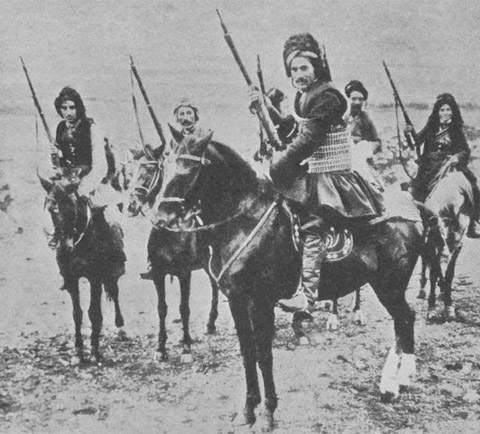
Hamidiye cavalry
According to Turkey there was no genocide. The government, like any Turkish government before it, claims that all the people in the eastern regions of the Ottoman Empire, both Turks and Armenians, were subject to violence and became victims of war, and that there was no intensions to wipe the Armenians off the face of the earth.
G-word without hesitation
Many Turks defend that vision. It is thus remarkable that many Kurds do use the ‘g-word’ without hesitation. Both civilians and representatives of the Kurdish political movement, which struggles for equal rights for Kurds, even offer their apologies for it. ‘The order to murder came from the Ottoman government’, Abdullah Demirtas says, ‘but the Kurds helped carry out the murders. Not as a Kurdish nation, because the Kurds hadn’t developed yet as a nation like now, but they did as Muslims.’
Demirbas tells about Kurdish militias, the infamous Hamidiye cavalry, which rampaged, instructed by the government, but also about civilians: ‘Some believed that they would go to heaven if they murdered seven Armenians. Buteven those who didn’t murder, but didn’t resist either, are to blame. Our silence makes us accomplices.’
What makes the Kurds so different to the majority of the Turks? Nurcan Baysal, writer and researcher in Diyarbakir: ‘Not long after the genocide, Kurds too became the victims of the state. Mass murder, suppression, it all started right after the founding of the Republic of Turkey, in 1923. We Kurds, we are still here, but we and the Armenians share a fate.’
Children and grand children
The armed Kurdish struggle for more rights, which was started in the early 1980’s by the Kurdistan Workers Party (PKK), brought about major changes, Baysal says: ‘The war between the PKK and the Turkish army was especially fierce in the nineties, leading to a lot of state violence against Kurdish citizens: torture, disappearances, the destruction of hundreds of villages, extrajudicial executions. This stirred op memories of the Armenian genocide amongst elderly Kurds. They started sharing their stories with their children and grand children. They felt ashamed. I also feel ashamed. I travel a lot, and whenever I meet Armenians, I apologize for what the Kurds have done.’
The commemoration on Friday was held at another Armenian church in the historical quarter of Diyarbakir, the Surp Sarkis church. It must be the most forgotten Armenian church in town, since even people who have been living in these small back streets for decades have no clue where to find it: everybody points in a different direction, everybody thinks he knows where it is but nobody really does. Eventually, it was found dilapidated amidst almost equally dilapidated houses in almost deserted streets.
FRÉDERIKE GEERDINK
Fréderike uses Beacon to tell stories about the Kurdish people. The Kurdish people have massive influence in a volatile region, but lack a country and lack a voice. As the only foreign reporter in the Kurdish capital of Diyarbakir, Fréderike shares what’s happening on the ground.
 FRÉDERIKE GEERDINK