Leather Shoe – 5,500 years old
 Leather Shoe – 5,500 years old
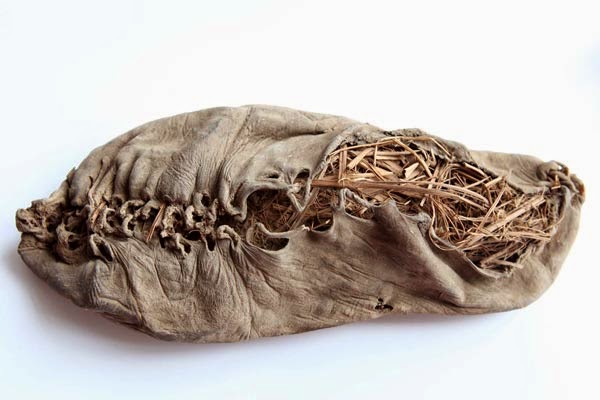 A perfectly preserved shoe, 1,000 years older than the Great Pyramid of Giza in Egypt and 400 years older than Stonehenge in the UK, has been found in a cave in Armenia. The 5,500 year old shoe, the oldest leather shoe in the world, is made from a single piece of cowhide, cut into two layers, tanned and laced. It contained grass, although the archaeologists were uncertain as to whether this was to keep the foot warm or to maintain the shape of the shoe. “It is not known whether the shoe belonged to a man or woman,” said lead author of the research “We thought initially that the shoe and other objects were about 600-700 years old because they were in such good condition,” said Dr Pinhasi. “It was only when the material was dated by the two radiocarbon laboratories in Oxford, UK, and in California, US that we realised that the shoe was older by a few hundred years than the shoes worn by Ötzi, the Iceman.” Three samples were taken in order to determine the absolute age of the shoe and all three tests produced the same results. Interestingly enough the shoe very much resembles a traditional Armenian shoe known as “charokh” a type of moccasin, still in popular use in Armenia.
Source: http://www.sciencedaily.com/releases/2010/06/100609201426.htm
Sky Observatory – 7,500 years old
 Sky Observatory – 7,500 years old
 “Carahunge” or “Zorats Karer” (also known as the Armenian Stonehenge) is a megalithic stone circle located some 200km from the Armenian capital Yerevan, not far from the town of Sisian. The name derives from “Car” for “stone” and “hunge” for “sound” or “voice”, meaning “singing stones”. The structure is believed to be a sky observatory due to the enigmatic holes drilled in the stone pointing at the cosmic bodies like the sun, the moon and the stars. It is specifically aligned with the Cygnus constellation and its brightest star Deneb. Being over 2000 years older than the Stonehenge it is believed to be the oldest known sky observatory. However, only since the middle of the 80ies, Carahunge was first interpreted as an archaeoastronomical monument and was studied by Prof. E.S. Parsamian (1999) and Prof. P.M. Herouni (1998) who have dated the structure to around 5,500 BCE. There are 222 stones with a total extent exceeding 250 metres, including 84 with holes (with 4-5 cm diameters).
Source: http://www.aras.am/Archaeoastronomy/astronomyancientarmenia.html
Human Brain – 6,000 years old
 Human Brain – 6,000 years old
 In a cave overlooking southeastern Armenia’s Arpa River a team of international scientists have uncovered three Copper Age human skulls, each buried in a separate chamber. The skulls belonged to 12- to 14-year-old girls. The team in Armenia, comprised of 26 specialists from Ireland, the United States and Armenia, had been excavating the three-chamber cave where the brain was found since 2007. “The preliminary results of the laboratory analysis prove this is the oldest of the human brains so far discovered in the world,” said Dr. Boris Gasparian, one of the excavation’s leaders and an archeologist from the National Academy of Science’s Institute of Archaeology and Ethnology in Yerevan. “Of course, the mummies of Pharaonic Egypt did contain brains, but this one is older than the Egyptian ones by about 1,000 to 1,200 years.” The cave’s damp climate helped preserve red and white blood cells in the brain remains. Genetic research is underway.
Source: http://www.popsci.com/scitech/article/2009-01/archeologists-unearth-oldest-old-world-brain
 Wagons – 4,000 years old

 Wagons – 4,000 years old
Over a dozen rich burials have been excavated in Armenia. The most spectacular were those excavated at Lchashen on the borders of Lake Sevan where a more than a dozen almost complete four-wheeled and two wheeled wagons, as well as two wheeled chariots with spoked wheels were uncovered. Two of these wagons form a spectacular display in the National Museum in Armenia. The four solid wheels are made from three planks of oak, while the interior is covered by a covering of withies. In his chronology (Timeline of the Development of the Horse, 2007) Beverley Davis describes these wagons as follows: “Primitive wagons dating from this time (2000 BCE) have been found in excellent condition in Armenia. These are the oldest known wagons in the world.” The wagons have also been included in Prof Stuart Piggott’s classic book “The Earliest Wheeled Transport”.
Source: 1) http://www.armeniapast.com/discovering-armenia/ 2) http://sino-platonic.org/complete/spp177_horses.pdf
 Skirt – 5,900 years old

 Skirt – 5,900 years old
Fragment of a skirt made of reed was found during excavations in the Areni-1 cave in southern Armenia. Pavel Avetisian, the head of the Institute of Archeology and Ethnography in Yerevan, informed that this artifact was discovered in 2010 and, even though they had informed about this precious item at the time, interest toward it grew further only recently. “The women’s clothing dates back to 39th century BC. So far we have discovered the skirt’s parts, which were superbly preserved. It is an amazing material with rhythmic color hues, and other remnants of the straw-woven material were also discovered. Such thing is recorded in Armenia for the first time,” Avetisyan noted. It’s considered the world’s oldest piece of reed clothing.
Source: http://www.huffingtonpost.com/2010/10/26/5900yearold-skirt-found-i_n_774429.html
Wine-Making Facility – 6,100 years old
 Wine-Making Facility – 6,100 years old
 In a cave in southern Armenia a team of international archaeologists have unearthed a wine press for stomping grapes. Fermentation and storage vessels, drinking cups, and withered grape vines, skins, and seeds have also been discovered at the site. The installation suggests the Copper Age vintners pressed their wine the old-fashioned way, using their feet. Juice from the trampled grapes drained into the vat, where it was left to ferment. The wine was then stored in jars—the cool, dry conditions of the cave would have made a perfect wine cellar. Ancient-wine expert Patrick E. McGovern, a biomolecular archaeologist at the University of Pennsylvania Museum in Philadelphia, called the discovery “important and unique, because it indicates large-scale wine production, which would imply, I think, that the grape had already been domesticated.” The apparent discovery that winemaking using domesticated grapevines emerged in what’s now Armenia appears to dovetail with previous DNA studies of cultivated grape varieties, McGovern said. Armenian Highlands are considered the birthplace of viticulture. It is believed the wine has been used for religious or ritualistic purposes. The discovery is important, the study team says, because winemaking is seen as a significant social and technological innovation among prehistoric societies. Vine growing, for instance, heralded the emergence of new, sophisticated forms of agriculture. They had to learn and understand the cycles of growth of the plant. They had to understand how much water was needed, how to prevent fungi from damaging the harvest, and how to deal with flies that live on the grapes. Chemical analysis of the residue has dated the winery to 4,100 BCE. “This is the earliest, most reliable evidence of wine production,” said archaeologist Gregory Areshian of the University of California, Los Angeles (UCLA).
Source: 1) http://graphics8.nytimes.com/packages/pdf/science/YJASC_2685.pdf 2) http://news.nationalgeographic.com/news/2011/01/110111-oldest-wine-press-making-winery-armenia-science-ucla/
Metal Smelting Foundry – 6,000 years old
 Metal Smelting Foundry – 6,000 years old
 Excavation of the ruins at a Bronze Age archaeological settlement of Metsamor in central Armenia has revealed a very large metal industry including a foundry with 2 kinds of blast furnaces. The foundry is known to have extracted and processed gold, copper, and several types of manganese, zinc, strychnine, mercury, and iron. Several huge underground caves were uncovered that are thought to have been storehouses for base metal. The first iron in the ancient world was probably forged here, though it was not as commonly forged as bronze. Metal from the foundries of Metsamor found their way to Egypt, Central Asia and China.
Source: http://www.ancient-wisdom.co.uk/turkeymetsamor.htm
Innovative Stone Age Tools – 325,000 years old
 Innovative Stone Age Tools – 325,000 years old
 Team of archaeologists and anthropologists from the United States and Europe led by Dr Daniel Adler of the University of Connecticut have discovered thousands of Levallois stone tools at the Armenian archaeological site of Nor Geghi dating from between 325,000 and 335,000 years ago. Suggesting that local populations developed them out of biface technique, which was also found at the site. Named after flint tools discovered in the 19th century in the Levallois-Perret suburb of Paris in France, Levallois technique is a distinctive style of flint knapping developed by early humans during the Paleolithic. The co-existence of the two techniques provides the first clear evidence that local populations developed Levallois technique out of existing biface technique. The discovery was published in the Science Journal and challenges the commonly held out of Africa theory of human innovation. These tools are the oldest outside of Africa, according to the published work: “Our data from Nor Geghi 1, Armenia, record the earliest synchronic use of bifacial and Levallois technology outside Africa”
Source: 1) http://www.sciencemag.org/content/345/6204/1609 2) http://www.sciencedaily.com/releases/2014/09/140925141224.htm
Depictions of Agriculture – 7,500 years old
 Depictions of Agriculture – 7,500 years old
 Armenia is home to numerous sites containing ancient petroglyphs with images of scenes of agriculture and domestication of animals. On the slopes of volcanic massifs of Armenia, 3000 meters above sea level, one can find whole galleries of rock drawings of agricultural motives. Some of these petroglyphs are dated as far as the 12th -11th millennium BC. People from later eras (Chalcolithic and Bronze Age) continued to record their prowess and beliefs on the stones. The largest variety and number of carvings date to this period and the early Iron Age. The first farmers depicted the great history of agronomics in these petroglyphic drawings. The symmetric arrangement of predominantly zoomorphic heroes was an indispensable attribute of the new times. These petroglyphs are carved onto dark brownish-black volcanic stones left behind by an extinct volcano. Although the site was discovered in the early 20th century, it was not really studied until the 1920s and again in the late 1960s; it is still not fully understood today. In his chronology (Timeline of the Development of the Horse, 2007) Beverley Davis describes: “Petroglyphs found in Armenia (one of the possible sites for the Indo-European homeland) show the oldest pictures of men driving chariots, wagons, and plows, with horses doing the pulling.”
Source: 1) http://ayfwest.org/news/ughtasar-the-petroglyphs-of-armenia/ 2) http://sino-platonic.org/complete/spp177_horses.pdf
 War Horses – 4,500 years old

 War Horses – 4,500 years old
Armenian archaeologists discovered an ancient burial site containing a large amount of sacrificed animal remains, among them war horses. The head of the Cultural Inheritance Research Center of Armenia Hakob Simonyan explained that the horse bones found at “Nerkin Naver” are the oldest yet uncovered belong to a domesticated horse used for military purposes. “This find dates back to the 26-25th centuries BC, and it’s the oldest burial place of a horse discovered to this day. It has an all-important significance not only for Armenia, but for the whole Western Asia as well,” Simonian said. Horse domestication and breading has for long been associated with ancient Armenia. Classical writers would often refer to Armenia as a land of excellence horse mastery. The ancient Greek historian Strabo describes Armenian war horses in several of his passages [11. 14. 9]: “Artavasdes (king of the Armenians), at the time when he invaded Media, showed, apart from the rest of the cavalry, six thousand horses drawn up in battle array covered with complete armor.” Horses have been considered sacred animals to the ancient Armenians and have been associated with the solar deity. Ancient Greek writers have equally recorded horse sacrifice in Armenia, Xenophon Anabasis [4. 5. 35] (430 – 354 BC) recounts: “Then Xenophon took the village chief back for the time to his own household, and gave him a horse that he had got when it was rather old, to fatten up and sacrifice, for he understood that it was sacred to the Sun-god. He did this out of fear that the horse might die, for it had been injured by the journey”. In almost all regions of the Republic of Armenia bronze horse bridles have been found, dating to the middle of the II millennium BC, and providing sound evidence of the existence of the numerous cavalry in the late Bronze Age. One of the most important was the bronze chariot model discovered in Loriberd near the town of Stepanavan. It shows battle scenes, where the warring armies consist of cavalry, heavy and light armed infantry, and units of transport. The image on the right is showing an iron horse-bit from the burial, which was prepared by forging technologies; which is the earliest example of an iron curb known to us.
Source : 1) http://hetq.am/eng/news/37962/“nerkin-naver”ashtarak-burial-site-reveals-its-ancient-treasures.html 2) http://www.perseus.tufts.edu/hopper/text?doc=Xen. Anab. 4.5.35&lang=original