Medvedev warns Armenia could become ‘new Ukraine’ as tensions with Moscow deepen
- (0)
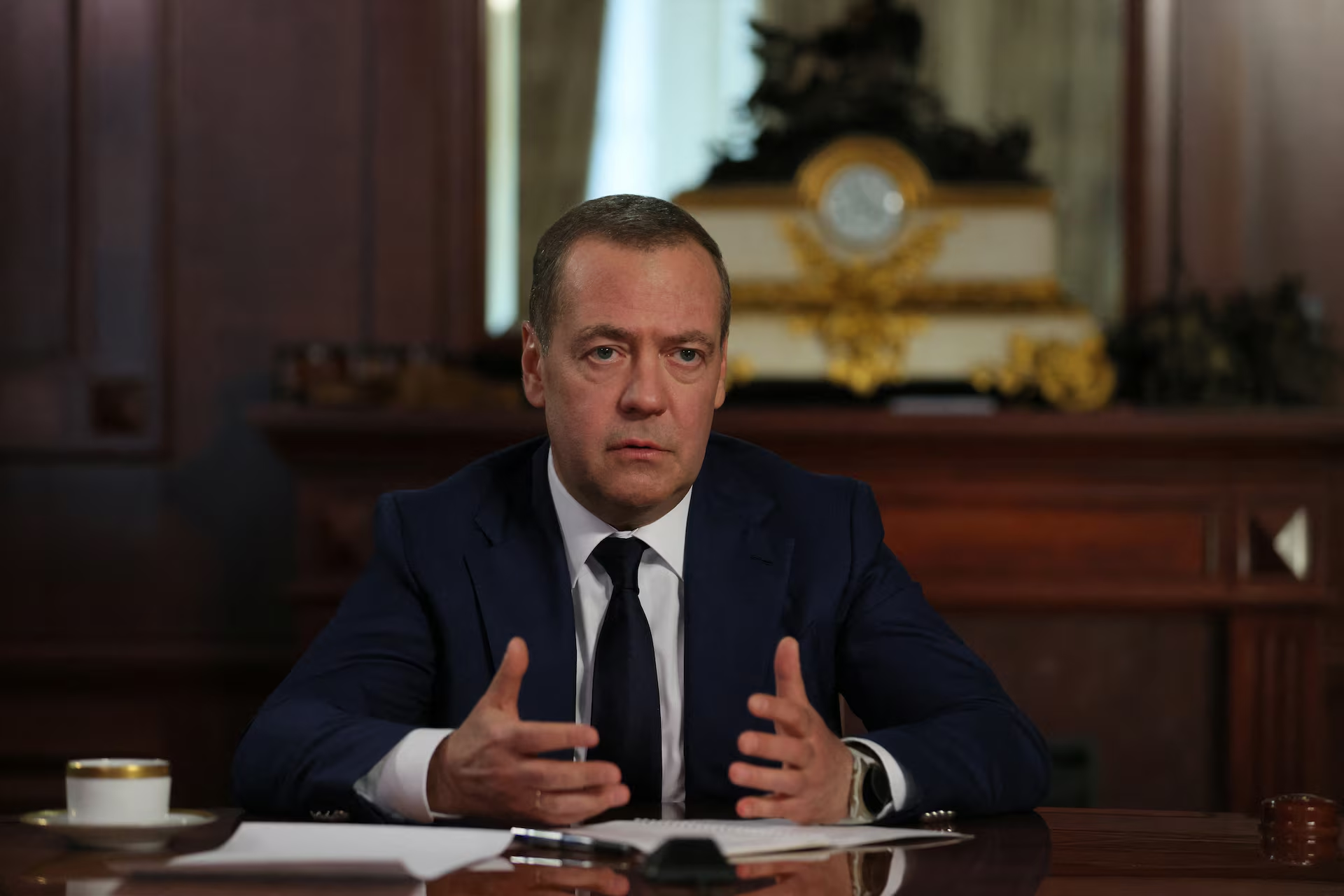
Russian Security Council Deputy Chairman Dmitry Medvedev has issued a stark warning over Armenia’s changing foreign policy, declaring that the “worst thing” that could happen to the country would be its transformation into a “new Ukraine.”
Medvedev, a former Russian president and one of the Kremlin’s most outspoken senior officials, made the remarks during an interview with Iran’s state broadcaster. He said Armenia’s current leadership had deliberately chosen to alter the country’s geopolitical direction and predicted that the policy would have negative consequences.
“The current Armenian leadership decided it was right to change the direction of its development. I am certain that this, too, will lead to nothing good,” Medvedev said. “The worst thing that could happen to Armenia is its transformation into a new Ukraine.”
Medvedev also claimed that outside powers were attempting to weaken Russia’s position in the South Caucasus and were now “testing” relations between Moscow and Yerevan. He pointed to Georgia’s previous pursuit of NATO membership and the subsequent deterioration of Russian-Georgian relations as another example of what he described as Western interference in the region.
The reference to Ukraine comes as relations between Armenia and Russia undergo their most significant transformation in decades. Yerevan has frozen its participation in the Russian-led Collective Security Treaty Organization and has steadily expanded political, security and economic cooperation with Western states and the European Union.
Armenia’s parliament adopted legislation in March 2025 launching a process of European integration. Prime Minister Nikol Pashinyan said in August that Armenia would likely begin the process of submitting a formal EU membership application in the near future, while acknowledging that eventual membership would require Armenia to make choices regarding its participation in the Russian-led Eurasian Economic Union.
The first Armenia-EU summit was held in Yerevan in May, with European leaders reaffirming support for Armenia’s sovereignty and stating that the country’s future must be determined freely and democratically by its citizens.
At the same time, Armenia’s newly adopted 2026–2031 government program no longer describes Russia as a “strategic ally” or refers to an Armenian-Russian “strategic alliance.” Instead, it calls for the “transformation and deepening of partnership relations” with Moscow as part of what the government describes as a balanced foreign policy.
Medvedev’s latest statement is not the first time he has drawn a direct parallel between Armenia and Ukraine. In May, he sharply attacked Pashinyan’s policies and said the Armenian prime minister was pushing the country down the same path as Ukraine. In August, Medvedev went further, predicting that Armenia would never join the European Union but would damage its relations with Russia and other EAEU members in the process.
The increasingly explicit Ukraine comparisons underscore the deterioration in political trust between Moscow and Yerevan. Russia continues to insist that Armenia’s deeper integration with European institutions is incompatible with its existing commitments within Russian-led structures, while the Armenian government maintains that its foreign policy diversification is a sovereign decision and that it continues to seek workable relations with Moscow.
Medvedev’s remarks nevertheless mark another escalation in the rhetoric surrounding that geopolitical shift, invoking the experience of a country that has been at war with Russia since Moscow’s full-scale invasion in 2022 as a warning about the possible consequences of Armenia’s westward orientation.