Human rights take a back seat as Canada moves to deepen ties with Turkey
- (0)
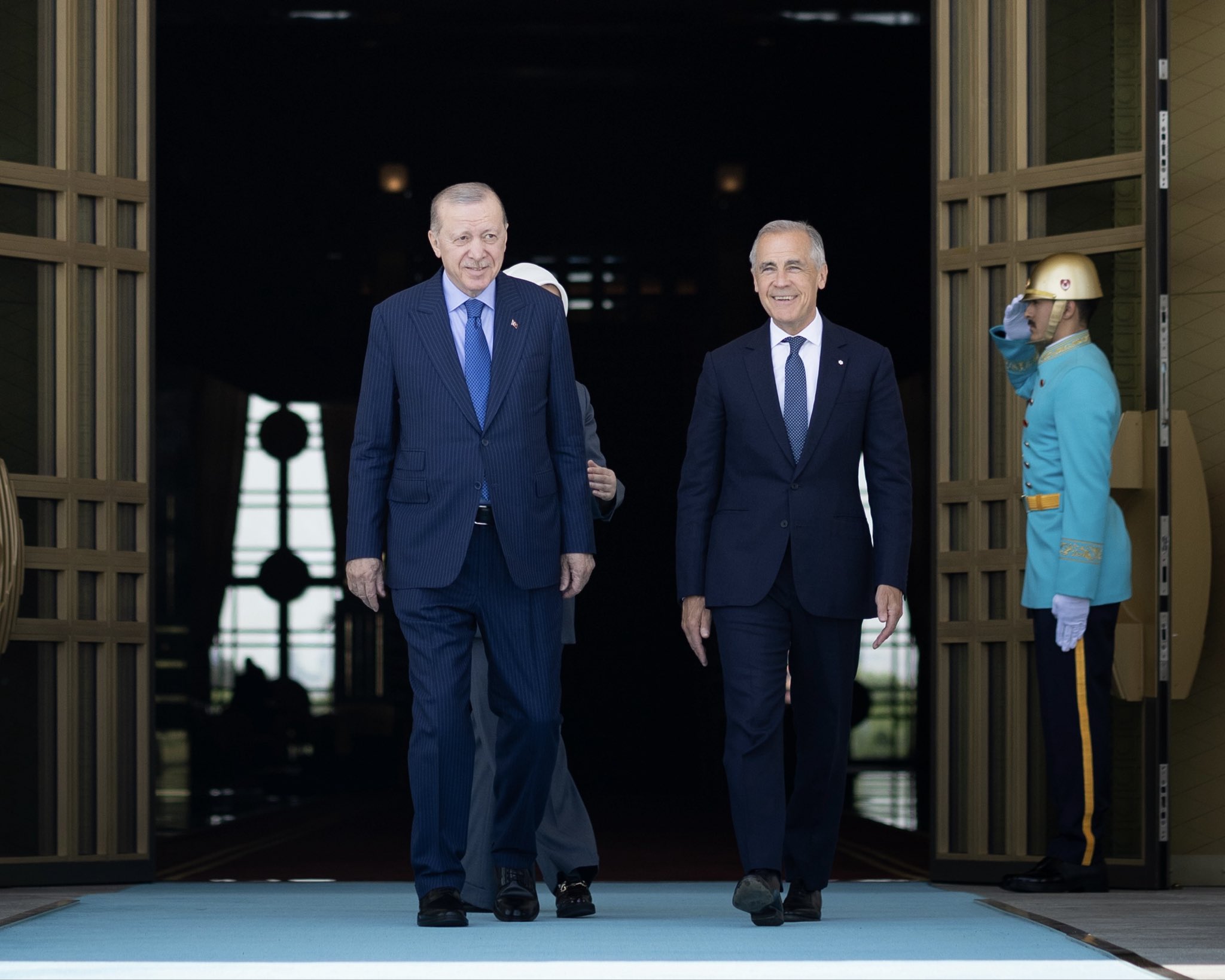
OTTAWA—Prime Minister Mark Carney is planning a bilateral visit to Turkey later this month for talks with President Recep Tayyip Erdoğan, as Ottawa moves to deepen trade, energy and defence ties with Ankara despite unresolved concerns surrounding Turkey’s past handling of Canadian military technology and its worsening human-rights record.
Reuters reported Friday that the visit, whose dates have not yet been publicly announced, would be the first dedicated bilateral trip to Turkey by a Canadian prime minister. Carney previously travelled to Ankara in July for the NATO Summit, where he and Erdoğan formally launched negotiations toward a Canada-Turkey free trade agreement. Defence cooperation, energy and the acceleration of those negotiations are expected to figure prominently in the upcoming talks.
The rapprochement comes as Carney seeks to diversify Canadian trade away from the United States. Bilateral merchandise trade with Turkey reached approximately $4.3 billion in 2025, while both governments have identified aerospace, defence, nuclear energy, mining and advanced technology as areas for expanded cooperation.
For many Canadians, however, any expansion of defence cooperation with Ankara inevitably brings renewed attention to the WESCAM controversy and the serious breakdown of trust that followed the 2020 Artsakh (Nagorno-Karabakh) war.
During the 44-day war, Canadian-made WESCAM electro-optical sensors were found to have been installed on Turkish Bayraktar TB2 drones used by Azerbaijan. Following an investigation, Global Affairs Canada concluded there was “credible evidence” that Canadian sensors exported to Turkey had been used in Nagorno-Karabakh, as well as in Libya and Syria. Ottawa’s review also found that Turkey’s transfer of WESCAM-equipped Bayraktar drones to Azerbaijan could be interpreted as inconsistent with assurances Ankara had provided only months earlier that the sensors would not be diverted, re-exported or transferred to a third party.
In April 2021, then-foreign affairs minister Marc Garneau went further, cancelling 29 suspended export permits and stating that the use of the Canadian technology was “not consistent with Canadian foreign policy, nor end-use assurances given by Turkey.”
The episode remains central to Armenian-Canadian concerns about renewed military cooperation with Ankara. Canadian-controlled technology provided to a NATO ally ultimately appeared on weapons systems used by Azerbaijan during a war against Armenians, despite assurances attached to the exports. The WESCAM case therefore remains more than a historical dispute over export paperwork; it raises continuing questions about how much confidence Ottawa can place in end-use guarantees when expanding defence ties with Turkey.
Canada nevertheless eased its restrictions in January 2024, ending the presumptive denial policy on military exports to Turkey and returning to case-by-case assessments. Under the new framework, Ankara must provide assurances indicating whether Canadian-controlled equipment will be transferred or re-exported to non-NATO countries, including when incorporated into another weapons system. Global Affairs Canada says permits can still be suspended or cancelled if credible evidence of misuse emerges.
The upcoming visit also comes amid growing concern over Turkey’s domestic human-rights record. Reuters noted that Carney has placed less emphasis on human-rights concerns than previous Canadian governments as he pursues new economic partnerships. Human Rights Watch says the Erdoğan government has intensified pressure on the political opposition, independent media, civil society and freedom of assembly. Istanbul Mayor Ekrem İmamoğlu, one of Erdoğan’s most prominent political rivals, was detained in 2025, while journalists and other critics have continued to face prosecution and imprisonment.
The pressure has continued into 2026. Ahead of the July NATO Summit in Ankara, Human Rights Watch reported that more than 200 people were detained in sweeping operations, including activists, lawyers, an academic and a journalist. Amnesty International has separately called on Turkey to end prosecutions and investigations targeting journalists for their reporting.
Those developments make the treatment of human rights a significant test of Ottawa’s developing relationship with Ankara. Canada continues to describe the protection of democracy, journalists, civil society and fundamental freedoms as central elements of its foreign policy.
There is also a distinct Armenian dimension. Carney reaffirmed Canada’s recognition of the Armenian Genocide on April 24, stating that recognition carries a responsibility to remember the persecution and atrocities committed against the Armenian people and to remain vigilant against their repetition. Turkey, meanwhile, continues to reject international recognition of the Genocide. In its own April 24 statement this year, the Turkish Foreign Ministry criticized politicians in third countries whom it said were exploiting the events of 1915 for political purposes.
Against that background, Carney’s visit will be watched closely by Armenian Canadians not simply for what new trade or defence arrangements emerge, but for whether the difficult issues in the bilateral relationship remain part of the conversation.
Ottawa has legitimate economic interests in expanding markets and reducing its dependence on the United States. But the history of Canadian-Turkish defence cooperation demonstrates that commercial and strategic engagement can carry consequences well beyond the bilateral relationship. The WESCAM experience, Turkey’s role in supporting Azerbaijan during the 2020 war, continuing concerns over democratic freedoms, and Ankara’s position on the Armenian Genocide remain part of that record.
The upcoming visit will therefore offer an important indication of how Canada intends to balance its increasingly pragmatic economic diplomacy with the human-rights, accountability and export-control principles it continues to publicly uphold.