
October 14, 2026
By Hasmik Baleyan | Horizon Weekly
As of January 21, 2026, the situation in Iran remains relatively calm. During protests in late 2025, both civilians and law enforcement officers were killed. However, the exact number of casualties remains unknown, as official figures have not been released by Tehran.
The protests, which began on December 28, 2025, attracted widespread regional and international attention. They were triggered by the sharp depreciation of the Iranian toman amid rising inflation. Initially, public anger focused on the currency’s volatility and its impact on wholesale and retail prices. In several cities, the demonstrations later escalated into clashes with police.
Over time, protest slogans became increasingly political, reflecting broader dissatisfaction with the country’s governance. Reza Pahlavi, the exiled son of the former Shah and a prominent opposition figure, criticized Supreme Leader Ali Khamenei and called for the removal of the current system and a return to the political framework of the pre-revolution era. The 68-year-old has said he is prepared to lead a transitional government, followed by a constitutional process and referendum to determine whether Iranians favor a monarchy, presidential system, or parliamentary system.
The current political system in Iran was established after the 1979 Islamic Revolution, which ended the rule of Shah Mohammad Reza Pahlavi and brought Ayatollah Ruhollah Khomeini to power. Reza Pahlavi is the son of the former monarch. Internet access in Iran remains restricted.
On January 17, 2026, Iran’s Supreme Leader Ayatollah Ali Khamenei addressed representatives from various segments of society, describing the unrest as “an American provocation” and accusing the United States of seeking to undermine Iran. He held Washington responsible for the losses and damage resulting from the protests and said the Iranian people had resisted disorder and would not tolerate internal or external wrongdoing.
On the same day, Iran’s Foreign Minister Abbas Araghchi held a telephone conversation with UN Secretary-General António Guterres to discuss regional and international developments.
In remarks on the unrest, Araghchi emphasized what he described as Israel’s “direct role” in arming militant groups and supporting the United States. He urged the United Nations to condemn attacks against security forces and civilians during the protests and criticized US and Israeli sanctions, saying they had worsened civilian suffering.
For his part, the UN Secretary-General stressed the importance of respecting fundamental human rights and opposed any interference in Iran’s internal affairs, including military intervention. He reiterated the principles of the UN Charter, particularly the prohibition on the use or threat of force.
Rising instability in Iran will increase Armenia’s security risks
According to the “2026 Report on the Foreign Security Risks of the Republic of Armenia,” the risk of renewed reciprocal strikes between Israel and Iran is expected to persist in 2026, potentially broadening Armenia’s security challenges.
“The effectiveness of Iran’s political system in managing current internal developments will likely be significant for the implementation of agendas promoted by regional and extra-regional actors. An increase in instability in Iran may further heighten Armenia’s security risks,” the report states.
The impact of developments in Iran on Armenia–Iran economic relations
Diplomatic relations between the Republic of Armenia and the Islamic Republic of Iran were established on February 9, 1992. Armenia’s embassy in Tehran was opened in December 1992. By presidential decree dated October 31, 2024, Grigor Hakobyan was appointed Ambassador Extraordinary and Plenipotentiary of the Republic of Armenia to the Islamic Republic of Iran.
On October 20, 2022, Iran’s Consulate General was opened in the city of Kapan. The foundational document governing bilateral relations is the “Declaration on the Principles and Objectives of Relations between the Republic of Armenia and the Islamic Republic of Iran,” signed in February 1992.
An interparliamentary friendship group operates between Armenia and Iran. The two countries have signed more than 190 international treaties, agreements, memoranda, and protocols covering nearly all areas of cooperation.
Iran’s Ambassador Extraordinary and Plenipotentiary to Armenia is Mehdi Sobhani, based in Yerevan.
Armenia’s Ambassador Extraordinary and Plenipotentiary to Iran is Grigor Hakobyan, based in Tehran.
Armenia–Iran trade and economic relations
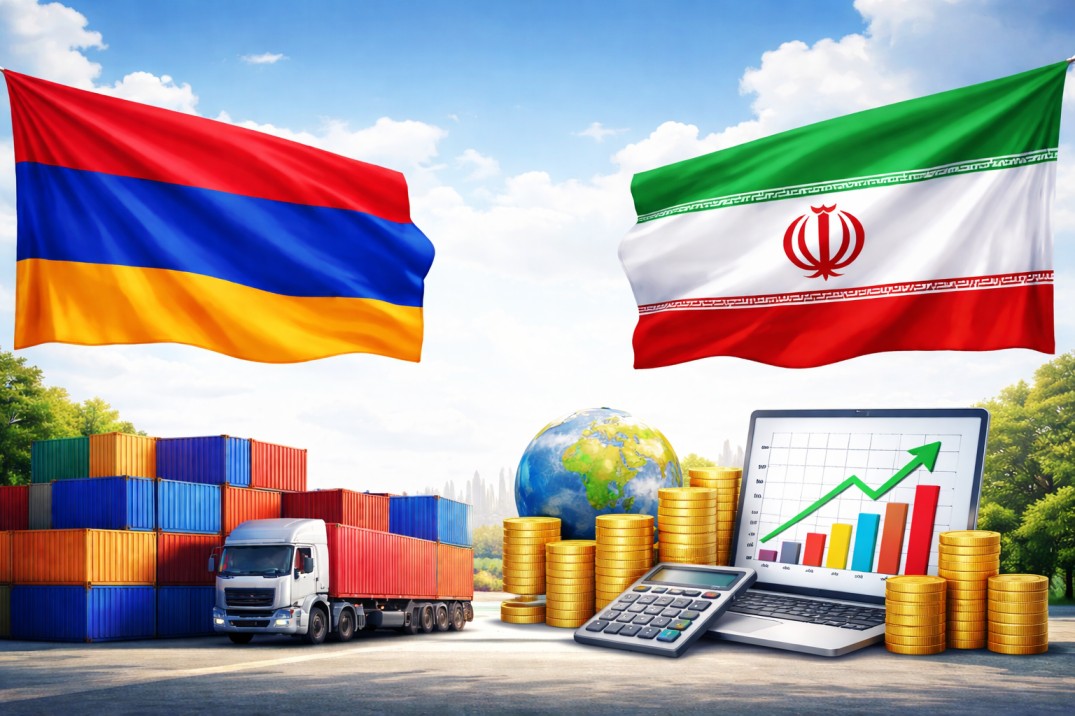
Cooperation between Armenia and Iran spans several sectors, including energy, transport, environmental protection, regional cooperation, education and science, and culture. Major joint projects include the bridge over the Aras River connecting Iran and Armenia, wind power facilities in the Pushkin Pass area, and the Iran–Armenia gas pipeline, which operates under a gas for electricity exchange scheme, whereby three kilowatt hours of electricity are supplied in exchange for one cubic meter of imported gas.
The two countries have also developed the first and second high voltage power transmission lines between Armenia and Iran, while construction of the third line is currently underway.
Tourism has also contributed to the expansion of trade and economic ties, with visitors from Iran accounting for a significant share of arrivals to Armenia.
Economist Suren Parsyan, speaking with Horizon, noted that Iran has been under various economic and political sanctions since 1979. Despite these restrictions, he said, the country has achieved several notable developments.
According to Parsyan, Iran’s economic situation has become more difficult over the past two years following the introduction of new US sanctions. These measures further reduced foreign currency inflows, including through restrictions on electricity sales from Iran to Iraq. Similar limitations were imposed on Iran’s energy trade with Qatar, where discounted gas sales had previously been settled in US dollars.
“Until recently, Iran exported electricity to Iraq and received payments in dollars. A similar arrangement existed with Qatar, which purchased gas at reduced prices and paid in dollars. These transactions were later subjected to strict sanctions,” Parsyan said.
He added that following Israel’s attack on Iran in June 2025, Iran was compelled to increase its military spending, including the purchase of air defence systems from Russia and China, which required significant foreign currency payments. As a result, a shortage of foreign currency emerged, leading to a sharp depreciation of the national currency.
“The exchange rate rose to around 150,000 tomans per dollar, compared to 70,000 to 80,000 tomans last year. This had a serious impact on the economy. The protests began in marketplaces and later spread nationwide, as the sharp currency depreciation significantly worsened living standards,” Parsyan explained.
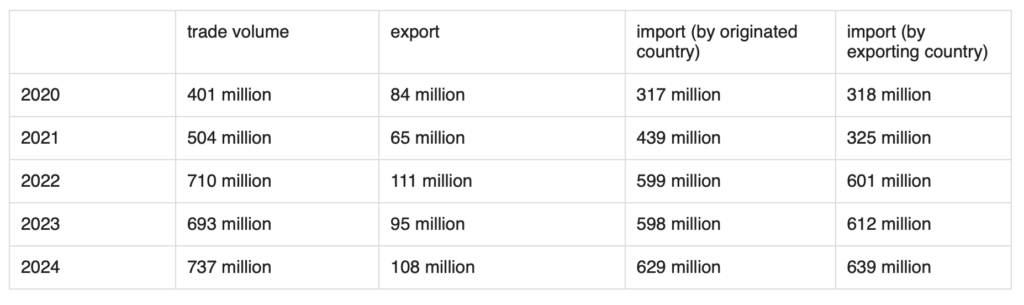
The economist also pointed out that, despite Armenia and Iran sharing an open border, Armenia’s exports to Iran remain relatively modest, amounting to around 100 million dollars. He noted that this figure is low considering the existing economic potential and favourable conditions.
Of this amount, Parsyan said, approximately 60 to 70 million dollars consists of electricity exports exchanged for gas, leaving only about 30 to 40 million dollars in manufactured and agricultural goods. These include tobacco products, meat, agricultural produce, and scrap metal.
“In practical terms, Armenia exports only about 30 to 40 million dollars worth of goods to Iran, while the rest is electricity. Armenia imports significantly more from Iran, totalling around 600 million dollars. About 350 million dollars, or more than half, consists of natural gas, followed by construction materials, chemical products, and agricultural goods,” he said.
As a result, Parsyan noted, bilateral trade turnover remains limited. He added that close ties with Iran are important not only economically, but also politically and in terms of transport connectivity, describing Iran as Armenia’s main gateway to the south.
“We must do everything possible to keep this gateway open,” he said.
Parsyan also noted that Armenia and Iran have a free trade agreement within the framework of the Eurasian Economic Union, which offers significant export opportunities. He emphasized that further organizational, technical, and economic efforts are needed to deepen bilateral cooperation.
Dependence on Iran remains significant in certain commodity markets
Recent developments in Iran temporarily disrupted trade between Iran and Armenia. Liquefied gas imports from Iran were suspended, leading to a sharp increase in prices in Armenia. According to economist Suren Parsyan, imports of liquefied gas from Russia usually slow down during the winter months due to difficult conditions at the Upper Lars border crossing, particularly during heavy snowfall. In such cases, Armenia typically relies on supplies from Iran.
“With the recent political tensions in Iran, exports were halted, which led to a 30 to 40 percent increase in liquefied gas prices in Armenia within a single week,” Parsyan said.
He noted that Armenia remains highly dependent on the Iranian economy in several specific commodity markets. This dependence extends beyond gas and includes products such as cement and other construction materials. While construction activity is generally lower in winter, reducing demand, similar disruptions could affect the market during peak seasons.
Several agricultural products are also imported from Iran, which may further influence Armenia’s economic stability.
“If we examine individual commodity markets, we can see that Iran has a noticeable impact on Armenia’s domestic market,” Parsyan said. “At present, Iran’s internal political situation is relatively stable, and efforts are underway to ease tensions. This is likely to reduce economic pressure as well. In the coming weeks, we expect trade with Iran to gradually return to normal.”
He recalled that a similar situation occurred in June 2025, when hostilities in Iran led to a temporary suspension of air transport. Flights resumed two to three weeks later, followed by the gradual recovery of trade and logistics links.
Despite the recent tensions, the gas-for-electricity exchange between Armenia and Iran continued uninterrupted. Supplies of natural gas from Iran and exports of Armenian electricity were not suspended. He added that during periods of heightened risk, Iran often builds up strategic reserves. As a result, Armenian exports to Iran, particularly meat products, tend to increase during such periods, as Iran seeks to secure food supplies from multiple sources.
Armenia and Iran maintain a free trade agreement that allows a number of goods to be exported with zero customs duties, including tobacco products, fruits, dried fruits, textiles, chocolate, and certain types of technical equipment. Parsyan noted that this makes the Iranian market potentially attractive for Armenian exporters. At the same time, he warned that sharp currency fluctuations in Iran create significant risks for exporters. Rapid changes in exchange rates can result in financial losses and undermine business stability. “For example, exporters may ship goods when the exchange rate is 120,000 tomans per dollar, only to see it rise to 150,000 within days, leading to major losses,” he said.
He also pointed to difficulties in financial transfers between Armenia and Iran, which are often conducted through Bank Mellat or private currency exchange offices. Differences between official bank rates and market rates further complicate transactions. “In some cases, the market rate may be 150,000 tomans per dollar, while bank transfers, often made in euros, are settled at much lower rates,” Parsyan explained. Additional challenges include limited market information, low activity among some Armenian businesses, frequent changes in Iranian regulations, halal certification requirements, and other administrative barriers.
“These are issues that can be addressed with sufficient coordination and effort,” Parsyan said. “Both countries have the willingness. What is needed is more effective organization and practical work to resolve them promptly.”
(This article was originally published in Armenian on January 22, 2026)
















Subscribe to our newsletter