Dr. Tessa Hofmann, Armenian Genocide Scholar, Receives Germany’s Highest Honor
- (0)
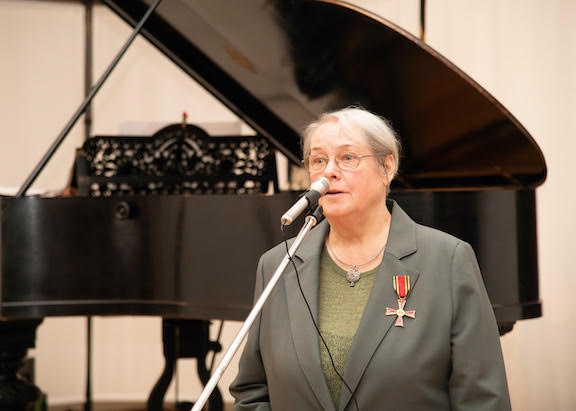
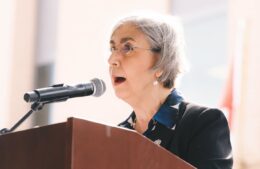
An ardent advocate for the international recognition of the Armenian Genocide and a dedicated genocide scholar Dr. Tessa Hofmann was presented Germany’s highest honor, the Order of Merit of the Federal Republic of Germany, during a ceremony on Monday.
German President Frank-Walter Steinmeier signed the order naming Hofmann as the recipient of the honor in June.
Hofmann is well-known for her civil society activities, particularly in her leading role in promoting recognition of the genocide against the Armenians and other Christian minorities in the Ottoman Empire, recognition that came in the form of a resolution passed by the Germany’s legislature—the Bundestag—in 2016.
Among those organizing support for this honor are in fact many individuals and organizations, of Germans, and especially Kurds, Alevites, Armenians, Greeks and Syrian Orthodox Aramaeans.
In a letter informing Hofmann about the honor in June, George Klussmann, the Berlin Mayor’s chief of protocol praised the scholar for her commitment to advocating for justice and human rights.
“With your exceptional personal achievements you have made an outstanding contribution to the common good of the Federal Republic of Germany. For this engagement, I render my thanks,” Klussmann said at the time.
The Germany-based Society for Threatened Peoples congratulated Hofmann, who has served as long-standing volunteer Armenia coordinator and companion, human rights activist and scholar at the organization.
“We are extremely pleased about this well-deserved honor,” said Sarah Reinke, the director of human rights work at the STP. “With her scientific expertise and tireless commitment, Tessa Hofmann has made a significant contribution to ensuring that the genocide of the Armenians is not only known in Germany, but also politically recognized.”
For decades, Dr. Hofmann has been committed to addressing and raising awareness of genocides—in particular, the genocide of Armenian, Assyrian/Aramaic, and Greek Orthodox Christians in the Ottoman Empire.
As founder of the Working Group for Recognition, Against Genocide, for International Understanding (Arbeitsgruppe Anerkennung, gegen Genozid, für Völkerverständigung), known as AGA, Hofmann played a key role in the German Bundestag’s recognition of the genocide in 2016.
When Azerbaijan began its nine-month hunger blockade of Artsakh in 2022, Dr. Hofmann was among the first to warn of genocide. Once again, she was tirelessly campaigning for reappraisal and recognition and urgently warning against the continued violence against Armenians.
Numerous publications, lectures, and campaigns can be traced back to her work.
Her books, “The Armenian Genocide in Court,” 1980, and “The Crime of Silence,” 1985, are still considered standard today in the field of genocide studies. At the same time, she played a leading role in the establishment of the Berlin Memorial for the Victims of the Genocide of Christians in the Ottoman Empire – the first of its kind in Germany.
“Tessa Hofmann is not only a scholar, but also a bridge builder,” Reinke continued. “She creates connections between academia and civil society, between the diaspora and the political public sphere – and in doing so, she always remains humane, respectful, and uncompromising in her work.”