The last nuclear guardrail is about to expire. What comes next?
- (0)
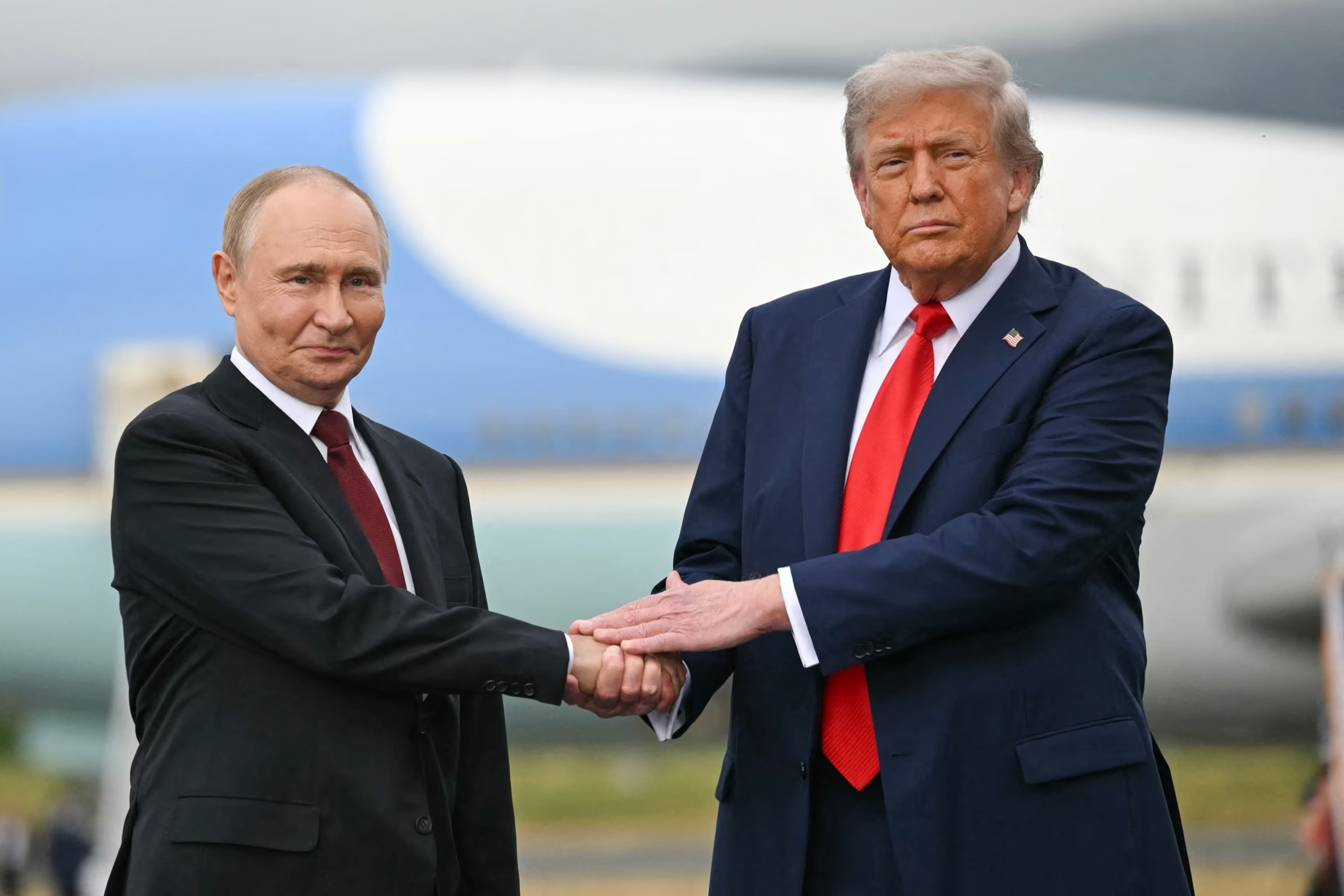
(Horizon Weekly) – On February 4, 2026, the New Strategic Arms Reduction Treaty (New START) will expire, ending the last remaining agreement that limits the nuclear arsenals of the United States and Russia. First signed in 2010 and extended once in 2021, the treaty has capped each country’s deployed strategic nuclear warheads at 1,550 and restricted the number of long-range delivery systems for more than a decade.
Beyond numerical limits, New START established inspection regimes, data exchanges, and notification requirements that reduced uncertainty and helped both sides understand each other’s nuclear postures. These measures were widely viewed as essential tools for maintaining strategic stability and reducing the risk of miscalculation.
That framework has steadily weakened in recent years. In 2023, Russia suspended on-site inspections, citing broader political tensions, and the United States responded by halting its own inspection activities. Despite this, both countries have largely continued to observe the treaty’s limits, suggesting a shared interest in restraint even as diplomatic relations deteriorated.
With the treaty’s expiration, those legal constraints will disappear. For the first time in decades, Washington and Moscow will face no binding limits on their deployed strategic nuclear forces. Analysts warn that this could remove a key brake on competition, making it easier for either side to increase warhead deployments quickly using existing stockpiles and delivery systems.
The implications extend beyond the two countries. New START has been a cornerstone of the global arms control system, and its lapse risks further erosion of transparency and predictability among nuclear-armed states. Without regular data exchanges and inspections, strategic planning may increasingly rely on worst-case assumptions, raising the risk of instability.
The treaty’s end also comes at a time of broader change in the global nuclear landscape. China is expanding its nuclear forces, and no comprehensive framework exists to include it in arms control discussions. The absence of New START may further complicate efforts to develop multilateral agreements suited to today’s geopolitical realities.
Diplomatic options remain uncertain. Russia has signaled willingness to continue observing New START limits temporarily, while U.S. officials have indicated interest in pursuing a broader agreement, potentially involving additional nuclear powers. So far, no successor treaty has been agreed.
As New START reaches its end, its expiration marks more than the loss of a single agreement. It underscores a turning point in nuclear diplomacy, raising urgent questions about how strategic competition will be managed in an increasingly fragmented and volatile security environment.