The European Union’s regional policy and Armenia (Part I)
- (0)
The EU: a power centre or a power pole?
By Gevorg Ghukasyan
Over the past decades, many scholars of international relations have debated, often without reaching a definitive conclusion, whether the European Union functions as a power center in global affairs or as a power pole that prioritizes the defence of its own interests and seeks a directive role in international relations. The EU’s continued unified policy during the Russia-Ukraine war, which began on February 24, 2022, demonstrates that, in relatively stable periods, the Union can function as a power centre. However, in times of instability, it can transform into a political pole, clearly recognizing and pursuing its own priorities. In both cases, it is evident that the European Union is a major global political actor whose complex behaviour does not lend itself to simple definition.
In recent years, the most serious challenge to the EU’s political influence has been the Russia-Ukraine war. Since early 2025, this has been compounded by increasingly strained relations with the new U.S. administration. The continued emphasis on American dominance within NATO, attempts by Washington to use political and economic leverage over European partners as tools of influence, territorial claims against the Kingdom of Denmark, and frequent efforts to interfere in European domestic politics have become new tests for the EU in its relations with its main strategic ally and largest partner.
In addition, the European Union faces serious internal challenges related to illegal migration, border management, and perhaps most significantly, the unprecedented rise of far-right political movements, particularly in countries such as Germany, France, the Netherlands, and Sweden.
Whether the EU will become a power pole or continue to exist as a power centre depends on how successfully it overcomes these challenges to the “European project.” In either case, it will remain a central actor in international relations.
Many experts trace the first signs of today’s instability in global affairs to Russian President Vladimir Putin’s well-known speech at the Munich Security Conference in 2007, when Russia criticized the US-led unipolar world and marked the beginning of a new phase of systemic confrontation with the West. This confrontation later manifested itself in the 2008 Russia-Georgia war, the annexation of Crimea in 2014, and the ongoing war in Ukraine since 2022.
Anticipating the erosion of the international order, the European Union attempted in 2009, through the Lisbon Treaty, to strengthen the European External Action Service (EEAS) and to better coordinate member states’ foreign policies without fully unifying them. In this context, the treaty was significant because it enabled the EU to act as a more coherent and predictable external actor in response to renewed great power competition and the weakening of the unipolar order, trends that became especially visible after 2007.
The EU’s system of external relations covers the entire world, with specific priorities, levels of engagement, and strategic visions for each country and region. Within the scope of this article, particular attention is paid to the EU’s regional policy in the South Caucasus and the Black Sea region.
In the South Caucasus, the EU’s interests are reflected in the European Neighbourhood Policy and the Eastern Partnership program, as well as in bilateral agreements with each country covering different levels of relations.
The European Neighbourhood Policy was launched in 2003 to manage relations with 16 neighbouring countries: 10 in the south and 6 in the east. According to official documents, its goal is “to avoid the emergence of dividing lines between an enlarged Europe and its neighbours, and instead to strengthen prosperity, stability, and security for all.”
One of the key platforms of Armenia’s EU relations, the Eastern Partnership, was launched at the Prague Summit in May 2009. It aims to strengthen and deepen relations with six partner countries: Armenia, Azerbaijan, Belarus, Georgia, Moldova, and Ukraine.
The Eastern Partnership focuses on four main priority areas:
- a stronger economy (economic development and market opportunities),
- stronger governance (institution building and good governance),
- stronger connectivity (transport, energy efficiency, and climate policy),
- stronger societies (mobility and people-to-people contacts).
Currently, EU Eastern Partnership relations operate at three levels: association (Georgia, Moldova, Ukraine), cooperation (Armenia), and partnership (Azerbaijan; Belarus is suspended). Subsequent geopolitical and regional developments have shown that the Eastern Partnership policy has largely failed. Ukraine is at war, while European influence in Moldova has been preserved only through direct intervention in elections.
On July 18, 2022, Azerbaijan and the EU signed a memorandum of understanding on strategic energy cooperation, with the aim of nearly doubling Azerbaijani gas exports to Europe. However, reliable sources indicate that the actual volume delivered via the Southern Gas Corridor is approximately 10 billion cubic meters annually, representing only 3 percent of EU consumption and 2 percent of imports. Under these conditions, this agreement is more of a political gesture to maintain some EU influence in Azerbaijan than a genuine diversification of energy supplies. Moreover, among Eastern Partnership countries, Azerbaijan appears to be the least engaged partner, apart from Belarus, where dialogue is frozen.
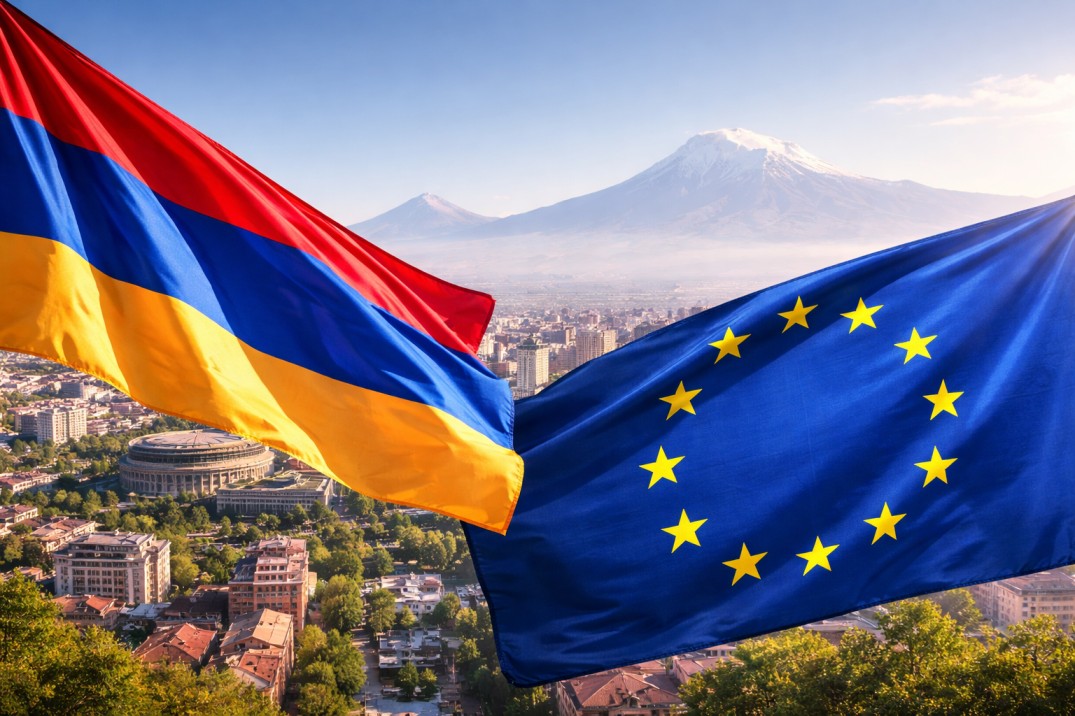
Under these circumstances, Armenia can now be regarded by Brussels as one of the region’s most important partners. Within the Eastern Partnership area, Armenia remains the only country in which relations with the EU are actively developing and where the European presence on the ground continues.
A cornerstone of Armenia’s EU relations is the Comprehensive and Enhanced Partnership Agreement (CEPA), signed in November 2017 and in force since March 2021. In essence, it reproduced the political component of the draft Association Agreement and aligned the economic provisions with Armenia’s obligations as a member of the Eurasian Economic Union. It remains one of the most ambitious and unique agreements in the entire Eastern Partnership area, covering all spheres of public life and elevating relations to a qualitatively new level.
It should be noted that even the Armenia EU Strategic Partnership Agenda, signed on December 3, 2025, is based on CEPA. The specific features of bilateral relations will be discussed in the second part of this article.
To better understand the EU’s regional objectives, it is important to examine two recent documents: the EU Global Gateway initiative and the joint communication of May 28, 2025, by the European Commission and the High Representative on the EU’s strategic approach to the Black Sea region.
The EU Global Gateway is a 300 billion euro infrastructure investment strategy for 2021 to 2027, aimed at building secure global connections in digital, energy, transport, health, education, and research sectors. It seeks to promote sustainable development, economic growth, and close global investment gaps through Team Europe cooperation and private sector mobilization.
Global Gateway is designed to enhance the EU’s competitiveness against American and Chinese economic dominance. Of its funding, approximately 79.97 billion euros is allocated to Sub-Saharan Africa and 77.16 billion euros to the Middle East and North Africa, while 28.49 billion euros is allocated to six countries in the South Caucasus and neighbouring regions.
Within this framework, the Sisian-Kapan 70-kilometre road section is under construction in Armenia’s Syunik Province, along with customs and logistics centres in Syunik and Yerevan. The same program includes plans for a Black Sea electricity cable through Georgia and Azerbaijan to connect regional power grids to Europe. Armenia has expressed interest in joining the project, but has reportedly been excluded, likely at Azerbaijan’s request.
The second document views the Black Sea region as a vital geo-strategic area linking Europe to the South Caucasus, Central Asia, and the Eastern Mediterranean. It identifies three main priorities: security, economic development and trade routes, and energy security and agricultural export guarantees.
The EU aims to support long-term security, sustainable growth, and stronger connectivity through multilateral partnerships and to assist some countries in moving closer to European integration.
In summary, during the current period of global transformation, the European Union is pursuing an active and initiative-driven policy to expand its influence in both direct and indirect neighbouring regions.
This approach was also reflected in European Commission President Ursula von der Leyen’s speech at the recent World Economic Forum in Davos, where she declared the end of the old global order and emphasized expanding EU economic influence in regions such as South and Central America and South and Southeast Asia, particularly through a major planned agreement with India.
She also stressed the importance of developing the EU’s own security capabilities and mechanisms, as part of building a more independent Europe.
Turning to the South Caucasus, under these conditions of intensified EU foreign policy, Armenia has emerged as a key regional partner, with relations rapidly developing. Armenia is also one of the few countries where the EU maintains a physical presence through its civilian monitoring mission. Most importantly, Armenia is a country whose people, political forces, and political culture are generally inclined toward sustained cooperation with the EU, provided that this does not turn Armenia into a stage for geopolitical confrontation.
Nevertheless, the stable development of Armenia’s EU relations may be adversely affected by the EU’s unilateral positioning in Armenia’s upcoming electoral processes, its open support for the current authorities, and attempts by those authorities to use European backing in domestic politics.
The recent transformations in Armenia’s EU relations, their nature, and possible future developments will be addressed in the second part of this article.
(This article was originally published in Armenian on January 27, 2026)
Gevorg Ghukasyan, (PhD in Political Science) is the head of Special Programs at the Central Office of ANC-International.
Related Articles

Մարտ 30, 2026