Մարտ 04, 2026
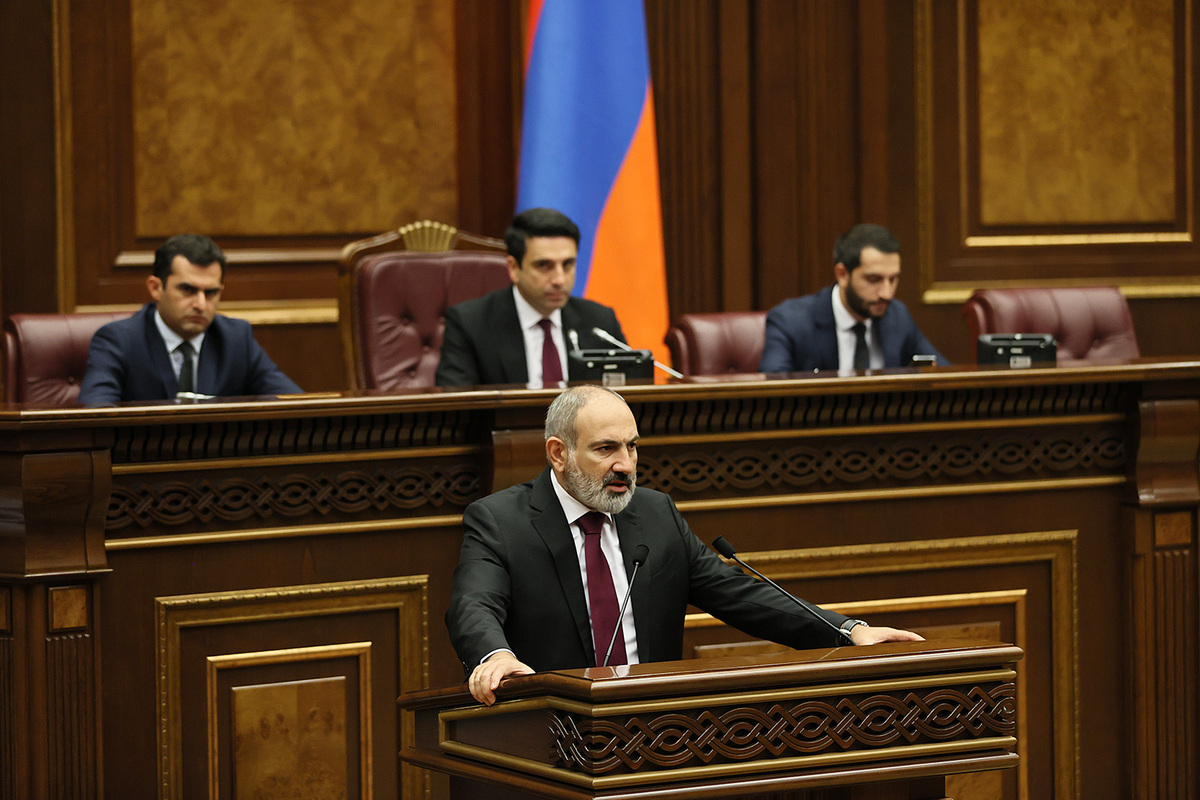
(Horizon Weekly) – Speaking during a government question-and-answer session in Armenia’s National Assembly, Prime Minister Nikol Pashinyan said that the energy systems of Armenia and Azerbaijan will be interconnected, presenting the development as unavoidable and inherently reciprocal. The remarks were made in response to a question from opposition MP Artur Khachatryan of the “Hayastan” faction, according to Armenpress.
Pashinyan claimed that the linkage would operate on equal terms, allowing both sides to access export and import opportunities on the same terms. His comments, however, left little room for debate over whether such a step serves Armenia’s long-term interests, instead framing the issue as a settled outcome rather than a policy choice.
To support his argument, he claimed that Armenia has already received part of the so-called mutual benefits. He pointed to a reported 20 percent reduction in gasoline prices as evidence that cooperation with Azerbaijan is already producing tangible results, without addressing broader market factors that may have influenced pricing or the durability of those gains.
Pashinyan also emphasized that imports of certain goods have begun, portraying this as proof that cooperation has moved from rhetoric to practice. As an example, he cited wheat imports into Armenia, asking rhetorically whether this should not be considered a reciprocal advantage. He added that, according to him, Azerbaijani officials are monitoring Armenia’s internal debate and questioning whether members of parliament will acknowledge that some benefits have already been delivered.
At the same time, he stated that Azerbaijani representatives claim they have provided transit corridors for Armenia through their territory, a formulation that echoes long-standing concerns within Armenia about asymmetry, terminology, and the political implications of such arrangements.
In parallel with these developments, Foreign Minister Ararat Mirzoyan and U.S. Secretary of State Marco Rubio recently confirmed in Washington a document on Armenia–U.S. cooperation within the framework of the TRIPP initiative, officially titled “Trump’s Roadmap for International Peace and Prosperity.”
The document outlining TRIPP’s implementation describes procedural steps for launching the initiative but explicitly states that it does not establish, and is not intended to establish, legal commitments or binding obligations for either Armenia or the United States. The emphasis on non-binding language underscores a recurring gap between ambitious political narratives and the absence of enforceable guarantees, a gap that increasingly defines the broader context in which Armenia’s regional and international engagements are unfolding.
















Բաժանորդագրվել