Pashinyan Invites Erdogan to Visit Yerevan
- (0)
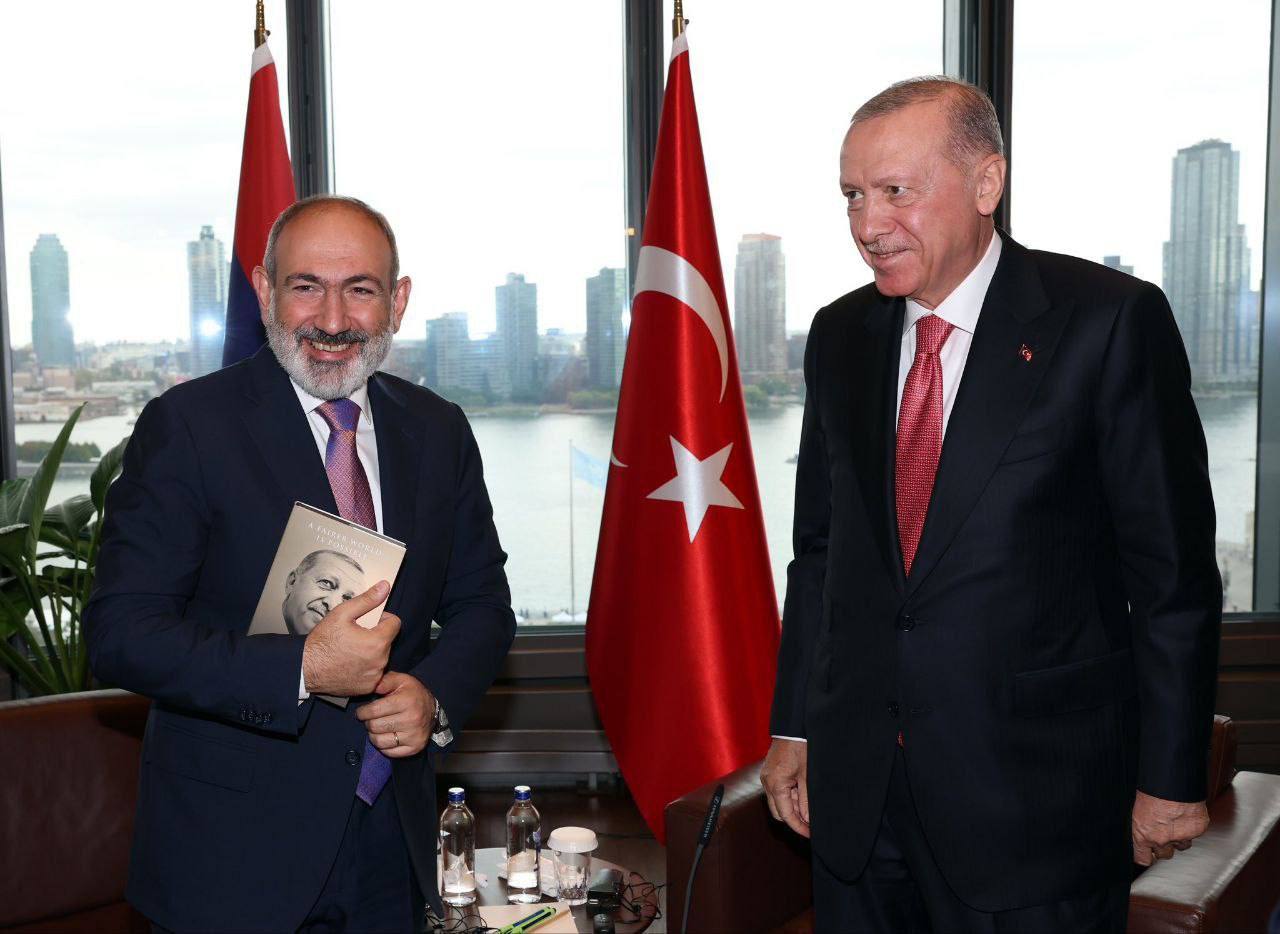
Armenian Prime Minister Nikol Pashinyan announced that he has officially invited Turkish President Recep Tayyip Erdoğan to attend the European Community Summit scheduled to take place in Yerevan in May 2026, a move that has stirred considerable controversy both inside Armenia and among Armenians abroad.
“I hope President Erdoğan accepts the invitation. We have met several times in recent years, and during my last visit to Turkey, I extended an invitation for him to attend the summit in Yerevan. It would not be appropriate for me to speculate on whether he will come,” Pashinyan said at the Orbeli Forum on “Establishing Peace and Multilateral Cooperation” on Tuesday.
The announcement has been met with unease by many who view Erdoğan as one of the region’s most hostile figures toward Armenia. For critics, the gesture symbolizes a dangerous willingness to normalize relations with a government that continues to deny the Armenian Genocide, maintains a closed border with Armenia, and stands firmly aligned with Azerbaijan, a country still holding Armenian prisoners of war and responsible for the depopulation of Artsakh’s Armenian population.
Nonetheless, Pashinyan presented the invitation as part of a new phase in Armenia’s foreign policy. He claimed that the country now enjoys institutional ties with all its regional neighbors, something he called “an unprecedented situation.” “We have always had friendly relations with Georgia and Iran, but there was no institutional connection with Azerbaijan and Turkey. This is important progress,” he said.
He also attempted to draw a distinction between “Armenian-Turkish” and “Armenia-Turkey” relations, arguing that the two are not identical concepts. “When we use terms like ‘Armenian-Russian’ or ‘Armenian-Turkish,’ they don’t always describe state-to-state relations,” he said, suggesting that Armenia is moving toward a more formalized, pragmatic relationship with its historic adversaries.
However, many observers see this as an overly optimistic and even naive view of regional realities. Turkey’s unwavering military and political alliance with Azerbaijan, ongoing threats to Armenia’s borders, and Ankara’s lack of any meaningful gesture toward reconciliation cast doubt on the notion that these diplomatic moves represent genuine progress.
Pashinyan concluded by asserting that relations with Turkey are “on the right track,” though he admitted that the pace of progress depends not only on political will but also on “gravitational factors,” a vague reference that many interpreted as the influence of larger geopolitical players.
While supporters frame Pashinyan’s initiative as a bold step toward peace and regional integration, critics see it as a troubling sign of appeasement at a time when Armenia’s sovereignty and security remain under constant threat. To many, inviting President Erdoğan to Yerevan, the same city that hosts memorials to the victims of the Armenian Genocide, is not a gesture of peace but a deeply symbolic misstep that risks undermining national dignity and collective memory.