Greek PM Mitsotakis visits Ankara as Turkey–Greece tensions persist beneath “Positive Agenda”
- (0)
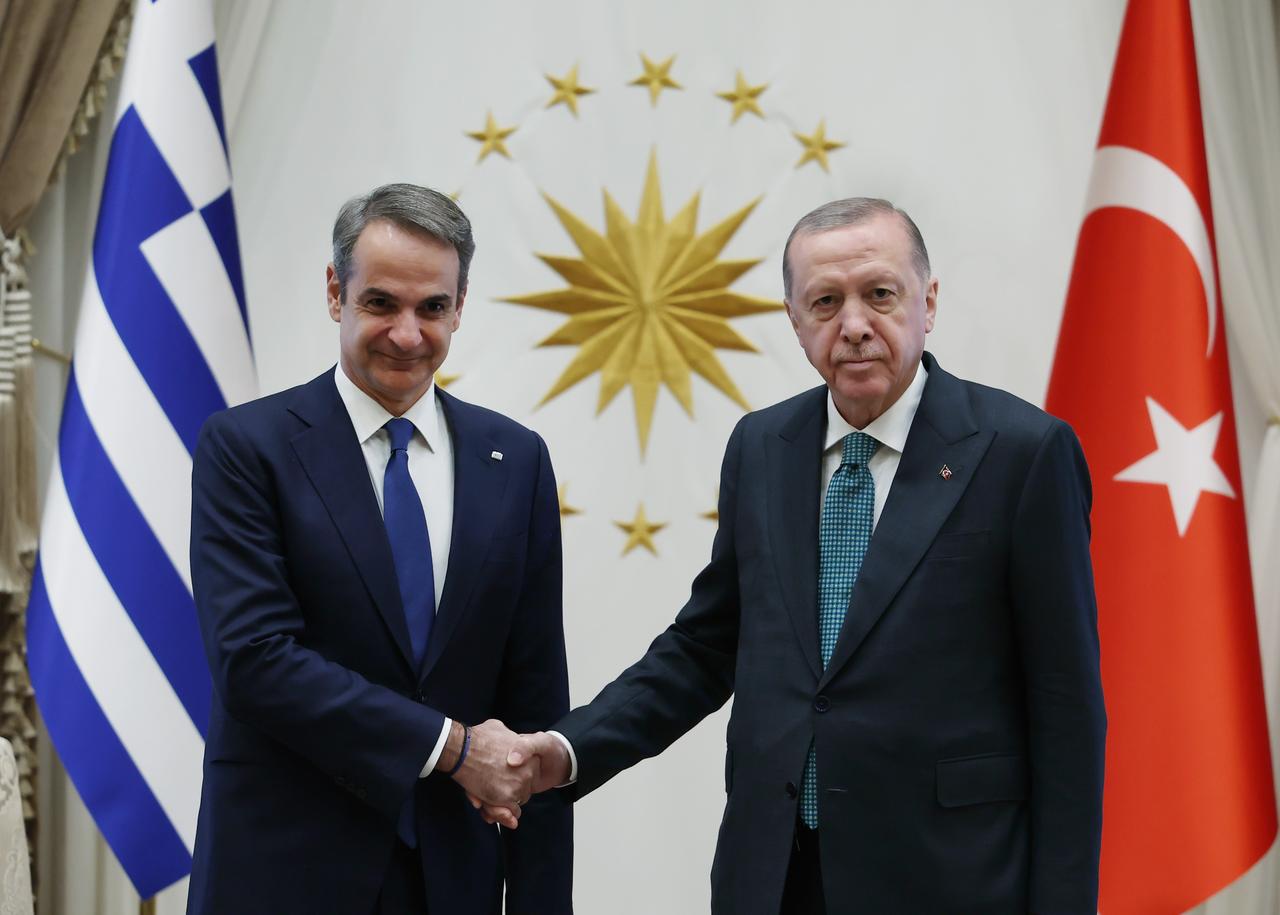
(Horizon Weekly) — After nearly two years without a high-level visit, Greek Prime Minister Kyriakos Mitsotakis travelled to Ankara last week for talks with President Recep Tayyip Erdogan, signalling a renewed effort to sustain dialogue between the two neighbours. The closed-door meeting was followed by the 6th session of the Turkey–Greece High-Level Cooperation Council. Mitsotakis was accompanied by nine ministers — notably excluding Defence Minister Nikos Dendias, who has previously taken a hard line toward Ankara.
The visit resulted in a joint declaration and seven cooperation memoranda covering trade, transport, infrastructure, tourism, and technical collaboration. Both governments reiterated their ambition to raise bilateral trade to $10 billion, up from the reported $6.7 billion recorded in 2025. Plans were also discussed to modernize border crossings, expand transport permits, revive the İzmir–Thessaloniki ferry route, strengthen rail connections, and increase flights.
Publicly, both leaders highlighted the so-called “positive agenda” — a framework formalized in 2021–2022 to lower rhetorical tensions while deepening practical cooperation. Erdogan emphasized keeping communication channels open, while Mitsotakis underscored the need to remove threats in order to stabilize relations.
Yet beneath the diplomatic language, core disputes remain unresolved. Chief among them is Turkey’s 1995 parliamentary declaration that a Greek extension of territorial waters in the Aegean to 12 nautical miles would constitute casus belli. Ankara has shown no sign of revisiting that stance. Meanwhile, tensions have periodically resurfaced through NAVTEX and NOTAM notices, widely viewed as tools of strategic signalling.
The Cyprus question also continues to divide the sides. Turkey maintains its support for a two-state solution, while Greece and the Republic of Cyprus back a bi-communal federal framework. Complicating matters further is Greece’s expanding strategic partnership with Israel, particularly in defence and energy, a development Ankara often regards with suspicion, especially within the broader Eastern Mediterranean energy competition.
Adding to the regional complexity, Turkey recently announced new oil exploration rights in Libya, reviving attention to the 2019 maritime agreement between Ankara and Tripoli, an accord that Greece and several European states consider contrary to international law.
Mitsotakis’s visit underscored a mutual desire to manage tensions and preserve dialogue. However, the structural disagreements shaping Turkish–Greek relations remain firmly in place. For now, the “positive agenda” functions less as a pathway to reconciliation and more as a mechanism for preventing escalation. Whether it can evolve into a durable confidence-building framework will depend on political will and on whether long-standing security concerns are meaningfully addressed rather than temporarily set aside.