Armenian researchers publish real information on cultural and historical heritage of Artsakh
- (0)
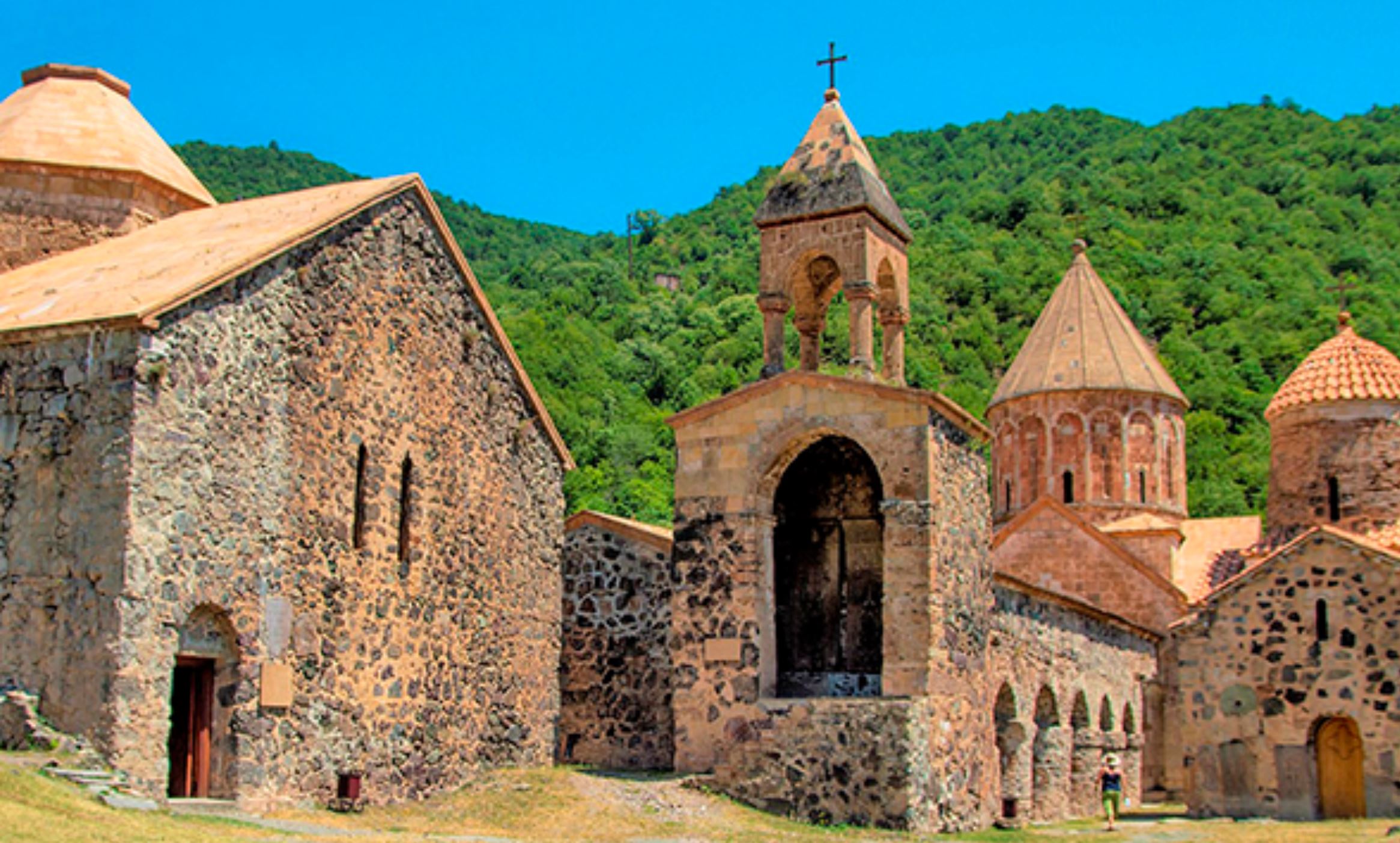
Researchers from the Institute of Archaeology and Ethnography of the National Academy of Sciences (NAS) of Armenia have received and studied data from official lists of monuments located on the territory of Soviet Azerbaijan as well as the state policy of Soviet Azerbaijan regarding these monuments, sourced from Russian archives.
According to a message from the NAS RA received by ArmInfo, the objective was to determine which monuments were recognized by the authorities of Soviet Azerbaijan in the Nagorno-Karabakh Autonomous Region and seven adjacent regions during the Soviet period before 1988, what policy was pursued regarding them and why Azerbaijan constantly mentions monuments destroyed by Armenians, without specifying their names.
It is noted that more than twenty official lists of monuments of Soviet Azerbaijan, compiled in 1946-1989 and submitted to the USSR Ministry of Culture and stored in the archive of the Dmitry Likhachev Research Institute of Cultural and Natural Heritage (Heritage Institute), have been studied.
“The comparison of the materials clearly demonstrates how, in the lists compiled during the Soviet period, the names of even very famous Armenian monuments were “forgotten” or their identity was actually changed. At the same time, it becomes obvious how much false “information” is being spread by the current authorities,” noted Hranush Kharatyan, head of the applied anthropology group at the Institute of Archeology and Ethnography of the National Academy of Sciences of the Republic of Armenia and candidate of historical sciences.
For example, she stated that there are hundreds of destroyed Azerbaijani monuments on the territory of the Republic of Artsakh, particularly, dozens of mosques, while in seven regions that were under the administrative jurisdiction of the Republic of Artsakh in 1992-2020 (Agdam, Lachin, Kubatlu, Kelbajar, Jebrail, Zangelan, Fizuli) from 1946 to 1989, a total of 154 monuments, both Christian and Muslim, are listed in more than 20 different official documents. “Among those, the largest number are mausoleums – 42 and mosques – 8. The question then arises: even with the greatest desire, how could the Republic of Artsakh liquidate “dozens” of the 8 existing mosques.
Christian monuments are only represented in a few lists: one monastery in Lachin and Kelbajar and four cave monasteries in Lachin and Kubatlu. Thousands of Armenian monuments are missing from these lists. Even the famous Dadivank in the Kelbajar region, which acquired great political value in Azerbaijan after the 2020 war, is not represented. It was a forgotten monument in Azerbaijan, destroyed during the Soviet period and only restored by the Artsakh authorities,” Kharatyan added. The first study completed by researchers so far covers the period from 1992 to 2020, listing monuments of seven regions under the control of the Republic of Artsakh and the NKAO.
According to Kharatyan, it is known that there were thousands of monuments on the territory of the NKAO. “The absolute majority of them, more than 90 percent, were Armenian. The research summarized in 1987 revealed that there were 1,700 historical and architectural monuments in the NKAO alone, including 60 monastery complexes and more than 500 churches. By region, the total number of monuments reached 520 in the Martakert region, 420 in the Hadrut region, 357 in the Martuni region, 250 in the Stepanakert (later Askeran) region, 123 in the Shushi region, including the city of Shushi. But in the 1968 lists, only 68 monuments of the NKAO were indicated, and in 1981 – only 58 were listed. Taking into account that out of 58 monuments on the list, 15 were monuments of the Soviet period, then the entire pre- Soviet past of the NKAO was represented by 42 monuments, of which only 18 were Armenian,” the scientist noted.
Referring to the absence of the Dadivank monument in the list, she noted that during the Soviet era, there was a famous Armenian monastery complex with a rich history in the Kelbajar region, called Khutavank or Dadivank, abandoned, destroyed, but preserved, with churches, bell towers, khachkars, manuscripts, a library, a refectory and guest houses.
According to her, in 1923, when the Nagorno-Karabakh Autonomous Region was created, Soviet Azerbaijan made every effort to ensure that Dadivank did not become part of the Nagorno-Karabakh Autonomous Region.It ended up in the Kurdistan district, hastily created in 1923. “The issue with Dadivank’s absence from the list of monuments was not that it did not have any historical or monumental value, but rather an attempt to conceal this famous monastery. It’s absent means that hundreds of other medieval Armenian monuments of the Kelbajar region are not there either. Dozens of churches with names such as Surb Karapet, Gevorg, Sargis, Grigor, Mariam Astvatsatsin and others, Karmiravank, medieval fortresses, khachkars, melik mansions, cemeteries with Armenian inscriptions, a significant part of which have been preserved, while some were partially destroyed during the Soviet period, were not mentioned,” Kharatyan added.
The researcher also noted that in 1940, archaeologist Yevgeniya Pchelina, who visited the region, reminded us of this, writing that in the Kelbajar region there are many ruined Armenian settlements, ruined and half- ruined churches, chapels, cemeteries, residential caves, testifying to the turbulent life of the past. Now they are scattered across an almost deserted area, and even their existence has not been confirmed, registered, or researched anywhere… She suggested that the reason for the “absence of monuments” in Kelbajar is that there were virtually no Muslim monuments in the Kelbajar region, not even a single mosque. “The entire “monumental past” of Kelbajar was exclusively Armenian. The Kurds and Turks, the most backward Azerbaijanis, did not build anything. No matter how poorly the Armenian cultural heritage was represented, it had to be balanced by the Muslim one, which was completely absent,” the report continues.
The NAS RA reported that the results of the study are currently being prepared for publication. In 2025, the abstract of the book “Monuments of Historical Artsakh in the Official Lists of Monuments of Soviet Azerbaijan in the 20th Century” will be presented for consideration to the Academic Council at the Institute of Archaeology and Ethnography.