Ապրիլ 02, 2026
(Horizon Weekly) – The governments of the Republic of Armenia and the United States have released the Implementation Framework for the Trump Route for International Peace and Prosperity (TRIPP), outlining plans for a long term multimodal transit project to be developed across Armenian territory.
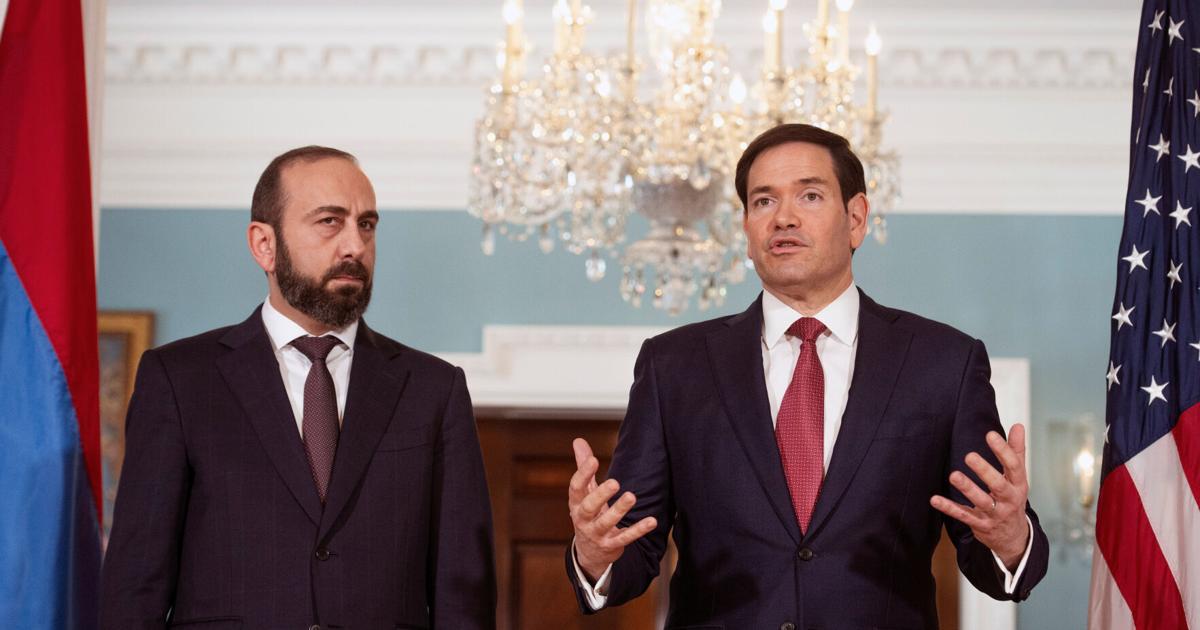
The framework was announced in Washington, D.C., following a meeting between Armenian Foreign Minister Ararat Mirzoyan and U.S. Secretary of State Marco Rubio. It follows the August 8, 2025 White House meeting at which Armenian Prime Minister Nikol Pashinyan and Azerbaijani President Ilham Aliyev signed a joint declaration on reopening regional communications.
According to the document, the TRIPP is intended to establish unimpeded rail, road, energy, and digital connectivity within Armenia, linking mainland Azerbaijan to its Nakhchivan Autonomous Republic and forming part of the Trans Caspian Trade Route connecting Central Asia to Europe. While the framework repeatedly emphasizes Armenia’s sovereignty and territorial integrity, it also confirms that the project is primarily designed to facilitate east west transit linking Azerbaijan, the Caspian region, and European markets.
A central element of the framework is the proposed establishment of a TRIPP Development Company, in which the United States would hold a 74 percent controlling stake, with Armenia holding 26 percent initially. The company would be granted exclusive rights to plan, build, operate, and collect revenues from designated transit routes within Armenia for an initial period of 49 years, with a possible extension of up to 50 additional years. Armenia’s equity share would increase only at a later stage, subject to future negotiations.
Although the framework states that Armenia retains full authority over border control, customs, taxation, security, and law enforcement, it introduces a front office back office model in which private operators contracted by the development company would manage documentation, payments, and other customer facing procedures. Armenian state institutions would retain final decision making authority, but the operational presence of private intermediaries would become a core feature of transit management.
The document outlines potential economic benefits for Armenia, including employment, investment, and access to new markets, but does not provide concrete figures, timelines, or revenue guarantees. Several key aspects of the project, including exact transit routes, security arrangements, financial exposure, dispute resolution mechanisms, and oversight structures, are deferred to future agreements and pilot phases.
The framework also makes clear that the project’s implementation is contingent on broader political developments, including further institutionalization of peace between Armenia and Azerbaijan, progress toward Armenia Türkiye normalization, and sustained U.S. engagement. These conditions place the viability of the corridor within an uncertain regional and geopolitical context.
While presented as a step toward regional connectivity and cooperation, the TRIPP Implementation Framework leaves substantial strategic, economic, and governance questions unresolved, with long term commitments proposed before many of the project’s operational and political implications are fully defined.

















Բաժանորդագրվել