Alen Simonyan declares Karabakh is Azerbaijan’s, dismisses use of name “Artsakh”
- (0)
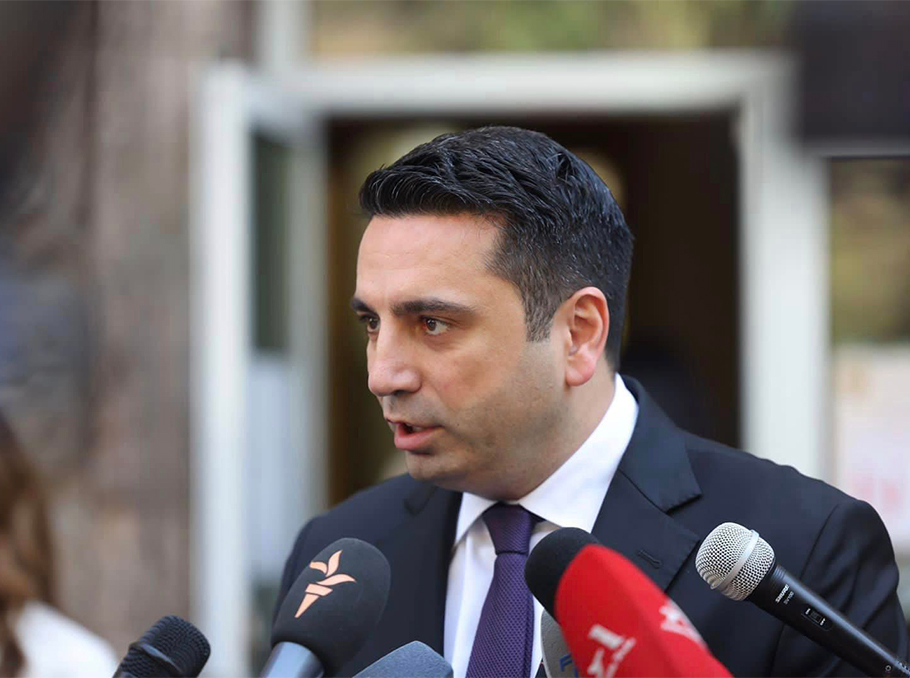
(Horizon Weekly / YEREVAN) — Armenia’s National Assembly Speaker Alen Simonyan stated that Karabakh is part of Azerbaijan and openly questioned the use of the name “Artsakh,” adopting rhetoric that directly mirrors Azerbaijani positions while dismissing longstanding Armenian historical and political claims.
Speaking to journalists, Simonyan defended Armenia’s role in the Prague process as a necessary step to preserve statehood, arguing that it secured the country’s territorial integrity and prevented scenarios such as loss of sovereignty or external domination. At the same time, he rejected criticism of Azerbaijani naming practices, going so far as to suggest that Armenians should not object if cities such as Yerevan are referred to by altered names abroad. He insisted there should be no reaction to such cases, reiterating his position that Karabakh belongs to Azerbaijan and questioning the continued use of any alternative designation.
The remarks effectively equate Armenian claims, rooted in history, identity, and recent conflict, with what Simonyan portrayed as unwarranted sensitivities, while normalizing the language and framing advanced by Baku. His statements mark one of the clearest acknowledgments by a senior Armenian official that the issue is no longer being treated as a matter of dispute, but as settled in Azerbaijan’s favour.
Simonyan further claimed that those who criticize the Prague process do not want Armenia to exist as an independent state, drawing a stark line between the government’s position and any dissenting view. This framing dismisses substantive concerns over the long-term implications of the process, including its impact on national rights, security, and political leverage.
Addressing substantive accusations that the government is yielding to Azerbaijani demands, Simonyan denied any such concessions, pointing instead to a pre-existing constitutional reform agenda. He defended ongoing discussions about removing references to the Declaration of Independence from the Constitution, arguing that “new realities” require adjustments. In doing so, he signalled a willingness to revise foundational state documents in line with the government’s current approach, a move that has raised serious questions about the erosion of Armenia’s political and legal framework.
Simonyan repeatedly justified the government’s direction by invoking the need to avoid renewed war, suggesting that preventing casualties outweighs other national considerations. He characterized the ruling Civil Contract party as the sole guarantor of peace, while labelling opposition forces as proponents of war, reducing a complex national debate to a binary political narrative ahead of the 2026 parliamentary elections.
He also pointed to what he described as harassment targeting his family and that of Prime Minister Nikol Pashinyan, though his remarks came amid broader public backlash against the government’s rhetoric and policies.
The statements follow a widely circulated March 22 incident in Yerevan’s metro involving Pashinyan and a woman displaced from Karabakh. The prime minister attempted to hand her a pin depicting Armenia’s map, but she refused it, stating that she identifies with a different version. The exchange escalated, with Pashinyan rejecting accusations that he had relinquished Karabakh.
The woman, Armine Mosiyan—daughter of Meruzhan Mosiyan, a field commander killed during the First Nagorno-Karabakh War in 1993—was later invited by Pashinyan to the government building for a public apology.
Taken together, Simonyan’s remarks and the surrounding developments reflect a government line that not only abandons longstanding national positions but also increasingly delegitimizes those who continue to assert them, framing dissent as a threat rather than a political reality.