After Defeat: Can Armenia’s Leaders Still Find Common Purpose?
- (0)
BY RAFFY ARDHALDJIAN
In an article I wrote for Asbarez in October 2024, titled “Preventing a Modern Day Alexandropol: Armenia’s Quest for Common Ground,” I explored the fragility of Armenian statehood and argued that without political consensus and strategic thinking, the country risks repeating the tragic patterns of its past. Today, five years after the devastating 44-day war of 2020, and nearly two years after the ethnic cleansing of Artsakh in 2023, the crisis in Armenia continues—not only on the ground, but also in the minds and hearts of its citizens.
The events of these past years have deeply wounded the nation. The loss of lives, land, and a sense of security has created a political and emotional paralysis. Yet instead of rising to meet the gravity of the moment, Armenia’s political class has continued to fracture. The ruling Civil Contract party, which regained a parliamentary majority in the June 2021 snap elections—despite having just presided over a military defeat—has failed to deliver on key promises of reform, resilience, peace and national restoration. Their response to the ethnic cleansing of Artsakh’s millennia-old Armenian population has been strikingly inadequate—administrative at best, and morally disengaged at worst.
At the same time, the parliamentary opposition has not managed to unite into a credible political force. Despite waves of protests, calls for impeachment, and moments of public frustration, opposition parties have largely spoken past one another. Their messages remain fragmented, their coalitions fragile. Even the most visible opposition alliances—the Armenia Alliance and I Have Honor—have struggled to offer a clear path forward. While they may have the resources and networks to organize, these assets have not translated into political traction.
What has emerged instead is a politics of accusation, often fueled by ego and legacy battles, rather than a politics of healing and rebuilding. Blame for the 2020 war, the fall of Artsakh, or Armenia’s growing isolation continues to circulate in circles—without any real closure or course correction. The need for national responsibility is often replaced by noise.
In 2021, former President Levon Ter-Petrosyan proposed an interesting idea: that the country’s three former presidents form an electoral alliance—not to run themselves, but to help unify and stabilize the opposition. His suggestion was rejected by both Robert Kocharyan and Serzh Sargsyan, who instead chose to lead their own electoral efforts—securing 29 and 7 seats, respectively, and entering parliament as a minority—while Levon Ter-Petrosyan’s party failed to pass the electoral threshold. History will no doubt analyze the long-term impact of the failure to unite and stop the reckless path pursued by the populist Civil Contract party in 2021. That moment passed, but its spirit remains relevant. Sometimes wisdom lies not in returning to power, but in helping others work together for the sake of national survival.
Today, Armenia finds itself in an increasingly dangerous neighborhood. The global power rivalry between Russia and the West continues to reshape the region. The war in Ukraine has drained Russia’s attention. Syria’s collapse in late 2024, and the 12-day Iran-Israel war earlier this year, have pushed instability closer to Armenia’s borders. Armenia cannot afford political incoherence at such a time.
There are pressing issues that require cooperation, not division: refugee integration, military reform, national security, and diplomatic strategy. Even if full political unity is out of reach, finding common ground among opposition forces on core national priorities remains possible. It requires maturity and a shared sense of consequence—especially at a time when the nation is in crisis.
Political thought in Armenia—and in the Diaspora—has an opportunity now to transcend personalities and power struggles. It can focus instead on forming a Minimum National Consensus for Armenia: a broad understanding of red lines, priorities, and values that can guide any government, regardless of who leads it. This is not about slogans. It is about quiet clarity, and shared responsibility.
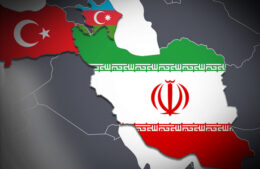
Such consensus could act as a buffer against rushed or ill-conceived treaties. There are credible concerns about a potential peace agreement with Azerbaijan being advanced in Dubai this July 2025 with Turkish facilitation. A peace treaty may well be desired by most Armenians, but not one negotiated recklessly or at any cost. A unified voice from the opposition is not necessarily a call for revanchism, but rather a reflection of a significant and growing segment of the population. Such a voice could help steer the process toward national dignity and long-term stability.
In recent interviews and posts, Dr. Arman Grigoryan of Lehigh University warned that Armenia’s current security posture entails growing risks. Escalation with Russia, he argues, could trigger consequences the country is unprepared to handle. Meanwhile, the ruling party’s assumption that a peace deal with Azerbaijan will resolve Armenia’s broader security dilemma appears, in his view, dangerously optimistic. Grigoryan has raised concerns about revolutionary governments—their tendency to elevate inexperienced individuals and pursue high-stakes decisions, in war or peace, without fully considering long-term consequences. Amid rising regional instability, a measured, realistic posture may offer Armenia more resilience than ideological fervor or unilateral gambles.
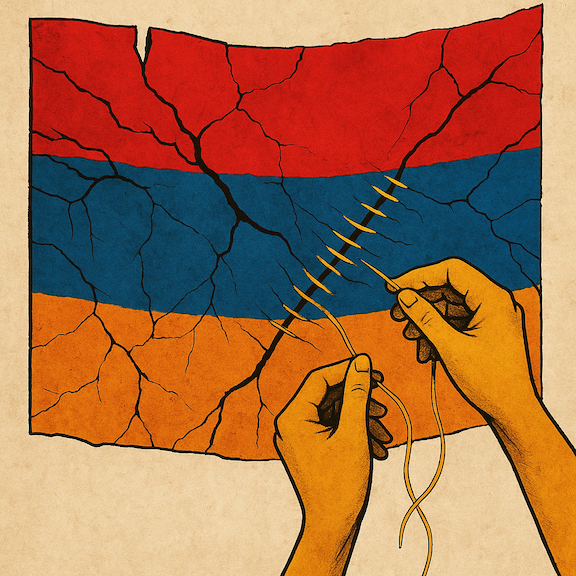
While calls to resist the recent clampdowns on the Armenian Church and opposition groups are valid and necessary, they are not enough on their own. What is needed now is a serious, coordinated effort to consolidate the fractured opposition forces into a credible political alternative. Without unity of purpose and strategic coordination, individual protests, reactive outbursts, or isolated statements of dissent are unlikely to shift the country’s current trajectory—or provide a meaningful safeguard against further democratic backsliding and strategic missteps.
A unified opposition offers more than a tactical response to the current government—it presents an opportunity to establish a transitional political framework rooted in realism and responsibility. This would not replace democracy but elevate it, by raising the bar of political discourse and action. Such a framework—drawing from diverse figures, resources, and traditions across Armenia’s political spectrum—could help reset the national direction and restore a sense of coherence and purpose. It would signal that this small country is capable of confronting its present challenges not through fragmentation, but through disciplined cooperation. More importantly, it would return focus to the unfinished business of the Armenian National Project—a long and costly struggle for sovereignty, survival, and self-respect that has defined the past 150 years. If Armenia’s political class, both at home and in the Diaspora, continues to dismiss the dangers facing the survival of the Republic—and fails to focus on clear national priorities—then history may not forgive the consequences. Stateless nations like the Kurds and Assyrians offer painful reminders of what can be lost when fragmentation overtakes vision.
And if such unity proves elusive amongst the opposition, then it may be time to ask why. What deeper habits, histories, or attitudes are preventing political cooperation – at least within the opposition – in Armenia? That question, too, deserves reflection.
At this critical juncture, Armenia does not need louder voices. It needs wiser ones.
Raffy Ardhaldjian is a Fletcher School graduate and advisor to tech companies, public institutions, and NGOs. In his spare time, he writes about strategic topics spanning Armenia and its global diaspora.